Labels

Tuesday, January 10, 2017

The Top 10 Best Films of 2016

1) SING STREET – 2016 probably won’t go down in the history books as one of mankind’s proudest years. And yet, amidst all the cynicism and bad news, this unassuming little Irish musical from Once director John Carney emerged, utterly exploding with wide-eyed optimism, exhilaration and unbridled joy. An enchanting coming of age yarn about a teenage musician’s awkward artistic awakening, Sing Street boasts a terrific, disarming cast (Jack Reynor, as our hero’s slacker brother, is a star in the making), huge fist-pumping underdog story highs and an infectious all-timer soundtrack loaded with rousing earworm confections. Although there were several remarkably moving films released in the past twelve months, none matched this charmer’s  gift for leaving the viewer beaming ear to ear, ready to take on the world no matter the obstacles. 

2) MOONLIGHT – No doubt about it, Barry Jenkins’ enthralling coming of age triptych chronicling the development of a young gay black man in the slums of Miami was the most beautifully compassionate and deeply human cinematic work of 2016. Utilizing its protagonist’s specific journey to tap into countless universal truths, Moonlight never falls prey to artifice, cliché or cheap sentiment. No, rather it achieves something far more powerful and pure: catharsis. Populated by a wonderful ensemble – with towering stand-out turns by Mahershala Ali and Naomie Harris – this is an utter miracle of a movie, humble in its intentions but genuinely enriching for the soul.  

3) MANCHESTER BY THE SEA – Casey Affleck’s been building up steam for quite some time, amassing an impressive number of sensational performances in predominantly independent fare. Here, in Kenneth Lonergan’s audacious examination of the messy grieving process, he at last earns his place among our current acting titans playing a directionless loner forced to return to his home town to care for his teenage nephew – played by extremely promising newcomer Ben O’Brien - after his brother passes. Keenly observant, raw and frequently funny (no, seriously!), Manchester by the Sea is an intensely touching account of a damaged man waging an exhausting daily battle to come to terms with the wreckage of his past.    

4) NOCTURNAL ANIMALS – Fashion designer extraordinaire Tom Ford’s wrenching sophomore directorial effort is brutal, unforgettable proof that he’s the real deal. A combustible cocktail of cinematic influences - including Lynch, De Palma, Hitchcock and the Coens - Nocturnal Animals feverishly mashes up Cormac McCarthy-esque neo-western fatalism with despairing upper class ennui to uniquely jaw-dropping results. Unfolding over two parallel tales – one in the real world occupied by Amy Adams’ unsatisfied gallerist, the other a fictional narrative involving Jake Gyllenhaal and a wry lawman played by the brilliant Michael Shannon – that slyly comment on one another, the film sees Ford playing the audience like a piano, masterfully controlling tension and leaving you dazed, captivated and out of breath.

5) CAPTAIN AMERICA: CIVIL WAR – Never satisfied to rest on its laurels, the Marvel movie machine’s thirteenth (!) production was its best yet; a classic clash of compelling crime-fighting ideals that’s as interested in colorful character psychology as pyrotechnics. Nimbly accommodating a veritable army of all-star icons, including headliners Cap and Iron Man, as well as insect-themed scene-stealers Spider-Man and Ant-Man, Civil War is pure blockbuster bliss fueled by its makers’ unabashed adoration for their vibrant comic-book universe. After seeing similar material done horrendously wrong the same year by the noxious Batman v Superman, this third Captain America adventure once again saw the House of M confidently reminding the world that when it comes to superhero cinema nobody does it better than them.

6) ARRIVAL – It’s so rare to encounter a science fiction film that feels truly original and authentic that when it happens it’s impossible not to be swept up in a feeling of revelation. Such was the case with Denis Villeneuve’s brainy and unexpectedly poignant first contact story featuring Amy Adams as a linguistics expert struggling to decode a daunting extraterrestrial language against a volatile political ticking clock. An expertly scripted adaptation of Ted Chiang’s “Story of Your Life,” Arrival offers a potent blend of engrossing intellectual curiosity and profoundly moving emotional fireworks, and is all but guaranteed for genre canonization in the years to come.


7) ZOOTOPIA – Continuing its astounding recent animation hot streak, Disney’s hilarious, sincere and surprisingly sophisticated take on the buddy cop genre doesn’t just cheekily tweak the genre; it also manages to be a clever and involving entry in it as well. Buoyed by winningly multi-dimensional heroes, energetic world-building, laugh out loud gags (the much-hyped sloth scene is bonafide comedic genius) and a message that, sadly, couldn’t be any more relevant, Zootopia represented the best in family entertainment in 2016. Forget Frozen 2, get Judy Hopps and Nick Wilde back on another case, and pronto! 

8) LA LA LAND – After 2014’s astonishing Whiplash, helmer Damien Chazelle became one of the most encouraging rising talents in the industry. Even still, though, it’s more than a little dumb-founding how effortlessly playful and graceful this delightful Singin’ in the Rain-inspired musical odyssey feels under his assured guidance. From its bouncy opening freeway dance off, to the magical, wistful final reverie experienced by irresistible leads Ryan Gosling and Emma Stone, La La Land both sweetly honors the traditions and conventions of classic Hollywood song and dance pictures and delicately hits all the right heartfelt notes a modern audience would hope for.

9) THE NEON DEMON – A bracing and sobering antidote to La La Land’s dreamy sun-soaked look at the City of Angels, uncompromising auteur Nicolas Winding Refn’s fashion world grotesque-a-thon is one sick and twisted wake up call. Starring a naively innocent Elle Fanning as an aspiring model grasping at fame while triggering predatory instincts in those around her, The Neon Demon takes the director’s repulsively gorgeous brand of synthetic hallucinatory pop filmmaking to its most unsettling conclusion. Thrilling, dazzling and icy, it’s a spellbinder that writhes and sways to its own haunting rhythms, the hell with the consequences.        

10) ROGUE ONE: A STAR WARS STORY – Rarely ever before has calculated franchise retconning been this inventive or exciting! Gareth Edwards’ kinetic prequel to A New Hope does exactly what it should; expanding the Star Wars universe in fresh and interesting ways, adding appreciated shades of grey to its typically black and white morality and delivering wonderfully grand big screen spectacle. The first real examination of war in the series, Rogue One exploits its “men on a mission” formula to spectacular effect, considering the human cost in a series that previously rarely slowed down long enough to do so. By the time the epic slam-bang final act comes to its triumphant conclusion there’s little doubt the force is still very, very strong.

Honorable Mentions: DE PALMA, THE EDGE OF SEVENTEEN, EVERYBODY WANTS SOME!!, FENCES, PETE’S DRAGON, THE WITCH

Tuesday, August 16, 2016

Film Review - SUICIDE SQUAD

Back in May Marvel proved with Captain America: Civil War it could skillfully juggle over a dozen major characters without sacrificing storytelling clarity and intelligence. On the flip side, Suicide Squad - Warner Bros. third entry in its increasingly distressing DC Universe mega-franchise – fails miserably to coherently portray its leads’ journey on foot across a few city blocks. This is sadly becoming par for the course for the studio, who have this time assembled a fun, colorful, well-cast batch of antiheroes and tossed them into a tornado of sloppy, shapeless narrative chaos. Like Batman v Superman, this film is so desperate to set up future sequels and spin-offs it furiously forsakes its own enjoyment and overall worth.

There’s a kernel of splashy Dirty Dozen-esque genius to the Suicide Squad concept – wherein a taskforce of homicidal marquee supervillains are forcibly drafted into an unwinnable battle – that screams cool. It’s a twist on the comic book picture we haven’t seen on screen yet, and bolstered by endless resources to achieve its wildest ambitions. Too bad, then, this movie’s feverish imagination mostly begins and ends with its flashy, gaudy costuming and temporary tattoo budget. If ever there was an opportunity to embrace the crazy this was it! Did we really need another generic “Stop the boring, vaguely defined villain from opening a sky portal!” story conveyed with all the live-wire energy of Batman doing an open mic night comedy routine?

Speaking of ‘ol Bats, it’s no coincidence popular members of his legendary rogues gallery dominate, with assassin extraordinaire Deadshot (Will Smith) and vicious vixen Harley Quinn (Margot Robbie) sharing the limelight, and the Joker (Jared Leto) periodically popping in from another (hopefully better) movie to boost marketability. The film makes zero effort to convince us they’re on equal footing with their dastardly supporting colleagues, who run the gamut from mildly amusing cartoons – Aussie safe-cracker Boomerang (Jai Courtney), fire-shooting Diablo (Jay Hernandez) and sewer-dwelling reptile Killer Croc (Adewale Akinnuoye-Agbaje) – to bland half-finished sketches. No doubt team leader Rick Flagg (Joel Kinnaman), Enchantress (Cara Delevingne) and Katana (Karen Fukuhara) are fascinating on the page, but here? Not so much. And what’s the deal with Slipknot? Adam Beach’s baddie appears to have been purposely edited out almost entirely, indifferently announced mid-picture with a hilariously speedy bit of dialogue blatantly pasted in during post-production.

So why has this insanely dangerous collection of psychopathic criminals with greatly varying abilities and powers been let out of their maximum security prison cells? Because fearsome government agency head Amanda Waller (Viola Davis, voraciously chewing scenery and spitting out exposition with grim purpose) believes America needs a secret weapon to thwart the potential threat of a Superman gone awry. However, just as her initiative is uneasily approved, vengeful eons-old witch Enchantress - who has body-snatched innocent archaeologist June Moone - escapes and awakens her unstoppable brother Incubus in order to destroy humanity. With the apocalypse fast dawning, Moone’s disgraced soldier lover Rick Flagg is forced into action alongside his disposable “suicide squad,” who are equipped with failsafe explosive devices and more than a little resentful about it. And, if the world being turned into a smoking husk wasn’t enough, ultimate wild card Joker devilishly schemes to free deranged girlfriend Harley from the clutches of justice.

One can be wholly forgiven for expecting Suicide Squad to be brimming with confidence. Lord knows, the omnipresent advertising campaign has projected nothing but! In reality, though, the film – which was written and directed by End of Watch and Fury auteur David Ayer – clearly isn’t. At all. Over-edited and reshot to death, the finished product bares the sweaty handprints of countless execs terrified of dropping the ball in the wake of Batman v Superman. Characters are introduced multiple times, vanish completely from the picture only to reappear without mention, and are given big climactic emotional beats that land with a thud due to their arcs being cut to shreds. The sporadically engaging first act is almost daringly unhinged; an extended series of mostly disconnected montages scored to a parade of idiosyncratic song choices, hastily scotch-taped together by Viola Davis voiceover. It’s something to behold certainly, and at least hints at a level of manic weirdness that never arrives once the central plot kicks in.

Given how visibly compromised Suicide Squad is it’s not fair to solely blame Ayer for how rudderless and incomprehensible the whole endeavor is. The film can’t even properly explain why Amanda Waller would form the group, given she’s friendly with Bruce Wayne (Ben Affleck) and other formidable heroes are shown to be active. More frustrating is the complete lack of tension and momentum in the plot. There’s no ticking clock and no compelling stakes to drive our antagonistic protagonists forward. You can feel the energy slacken as they wander aimlessly from one uninteresting fight scene to another without a clear mission objective, occasionally interrupted by talky diversions and unnecessary Joker business (the majority of Leto’s scenes as the Clown Prince of Crime – now a glitzy, angsty Scarface-wannabe who’s too silly to be scary – could be easily removed with no ill effect).

And yet, despite being a superhero spectacle lost cause, Suicide Squad gets two things very, very right; Deadshot and Harley Quinn. Every time Smith and the show-stopping Robbie – whose unqualified success as the fan fave villainess is slightly complicated by Ayer’s long-established misogynistic male gaze – are on screen we’re reminded we are in the presence of true movie stars. In a film over-burdened with dumb, empty posturing, they’re triumphant, exciting and hugely charismatic comic book translations that beg to be featured in a project deserving of their gifts. It’s a hoot to see them overshadow their underwritten co-stars and tangle (all-too-briefly) with Affleck’s Batman! Stop mucking about DC and get it done and done properly!

Problem is Warner Bros. and DC aren’t exhibiting much interest in cultivating well-crafted star vehicles for their rich staple of icons the way Marvel nurtured Iron Man, Thor, Captain America and the Guardians. And so we’re left with empty bundles of convoluted connective tissue like this and BvS and expected to care about buying into future chapters. Franchise building only works when the foundation is strong, people. Forget Harley and Killer Croc, the real Suicide Squad is the studio exec team spending innumerable precious days of their finite lives anxiously cranking these artless, unremarkable things out to muted response.

2 out of 5

Wednesday, July 06, 2016

Film Review - THE LEGEND OF TARZAN

There are two movies aggressively battling for dominance at the heart of The Legend of Tarzan, David Yates’s umpteenth update of Edgar Rice Burroughs’s classic literary icon. One is a genuinely fun, light-hearted throwback to post-Indiana Jones 1990s pulp adventures like The Mask of Zorro, The Phantom or Rudyard Kipling’s Jungle Book. The other, alas, is a brooding, gloomy, half-realized attempt to channel the gravitas of Christopher Nolan’s Dark Knight trilogy. These two approaches are so diametrically opposed to one another that the result is a confused, watchable mess with an identity crisis. It wants to swing freely and boldly from vine to vine, yet with heavy weights tied to its ankles.

Like so many misfired blockbusters, the project feels badly compromised by being over-developed. In the works since 2003, Tarzan was passed from director to director, with several writers attached. The final screenplay is credited to Adam Cozad (Jack Ryan: Shadow Recruit) and Craig Brewer (Hustle & Flow, Black Snake Moan), and undeniably feels like two very specific visions smashed together. After all, this is a film where multiple characters grimly mourn their deceased children while Christoph Waltz, playing a white suited, moustache-twirling baddie who chokes his prey with a ninja weapon-like rosary, shouts clichés like “Don’t shoot! You’ll hit the girl!” Either angle could theoretically be successful. Together, though? Tonal whiplash city.

An original tale, culling many elements from Burroughs’ stories, The Legend of Tarzan reintroduces us to famed jungle crusader John Clayton III (Alexander Skarsgård) years after returning to his ancestral home of Greystoke Manor in Victorian London. Living a respected, if stale, aristocratic life, he’s caught off guard when gun-slingin’ American envoy George Washington Williams (Samuel L. Jackson) urges him to investigate Belgium’s developments in the Congo. Extremely reluctant to accept the invitation, he ultimately decides to make the journey due to pressure from his wife Jane (Margot Robbie, suitably plucky in her pretty thankless job), who sees the trip as an opportunity to reignite their love affair and help ease the grief of losing their son. Soon after arriving, however, the trio becomes embroiled in a horrendous plot, overseen by King Leopold II’s representative Leon Rom (Waltz), to enslave the native population and dig up a vast diamond fortune. 

Director Yates, who so deftly balanced darkness with wonder and joy in the last four Harry Potter entries, would seem the perfect talent to somehow make The Legend of Tarzan’s clashing sensibilities work. Unfortunately he only half succeeds, imbuing the more high-spirited sections with the necessary energy. There’s a lot of welcome goofy and broad material, from set-pieces involving gorilla fights, Jurassic Park-homaging ostrich flocks, crocodile attacks and a nifty mass stampede, to small moments like (Apocalypto-inspired?) surgery via ant pincers, and some solid buddy comedy between Skarsgård and Jackson. These flights of fancy are a genuine kick, and leave one wishing for a version that really sold just how cool it would be to be Tarzan! Who wouldn’t want to pal around with fearsome animals, scamper around treetops and take down cartoonish bad guys in order to save the day?
Because, given the picture’s ridiculous $180-million-dollar budget (it was shot a couple years ago in a warehouse and given the Avatar/Jungle Book CG treatment), shouldn’t this be an unabashedly exciting family-friendly spectacle? It just makes economic sense. And every attempt Yates makes to try to get dark and somber fails miserably. No one buys a ticket to watch Tarzan mope and refuse to get his groove back, but that’s just what Skarsgård is forced to do for far more time than desired. We can buy Bruce Wayne, and his scary armored alter ego, as a tormented soul. A bare chested, tree-climbing hero in a loin cloth, though? Not so much. No matter how hard composer Rupert Gregson-Williams’s Hans Zimmer-lite score blares into overdrive trying to convince us we’re witnessing the mighty rebirth of a painfully serious superhero.

There’s also the issue of just how difficult and problematic this mythos is to transport to modern day cinema. Do we truly need another story about a brave Caucasian savior protecting African people? The superior 1999 Disney animated take smartly focused more on animal conservation. Here, though, our protagonist is responsible for thwarting slavery and talking sense into a deceived tribal chief (Djimon Hounsou, in a role so brutally undeserving of his considerable gifts). Making Jackson’s sidekick a fairly active participant in the direction of events helps a bit, however he's still a supporting player and no one on-screen champions him the way they do “the white ape.” The world was a very different place when Tarzan was introduced in 1912, and it’s highly debatable whether this is material that desperately needed to be resurrected in this form. And by making unwelcome stabs at being gritty and grounded, the movie invites more criticism than it might have had had it just been a silly and carefree swashbuckler.

Maybe we wouldn’t be motivated to ask these types of hard questions if Yates and his team had found a more compelling, thoughtful and artistically satisfying way to drag Burroughs’s brainchild into 2016. This adaptation isn’t an embarrassment (no comparisons are warranted, for example, to the disastrous and porny 1981 Bo Derek star vehicle Tarzan, The Ape Man), it just never really justifies itself. The Legend of Tarzan will probably please those receptive to its campier minor charms, but it’s certainly nothing to beat one’s chest for.

2.5 out of 5

Wednesday, June 29, 2016

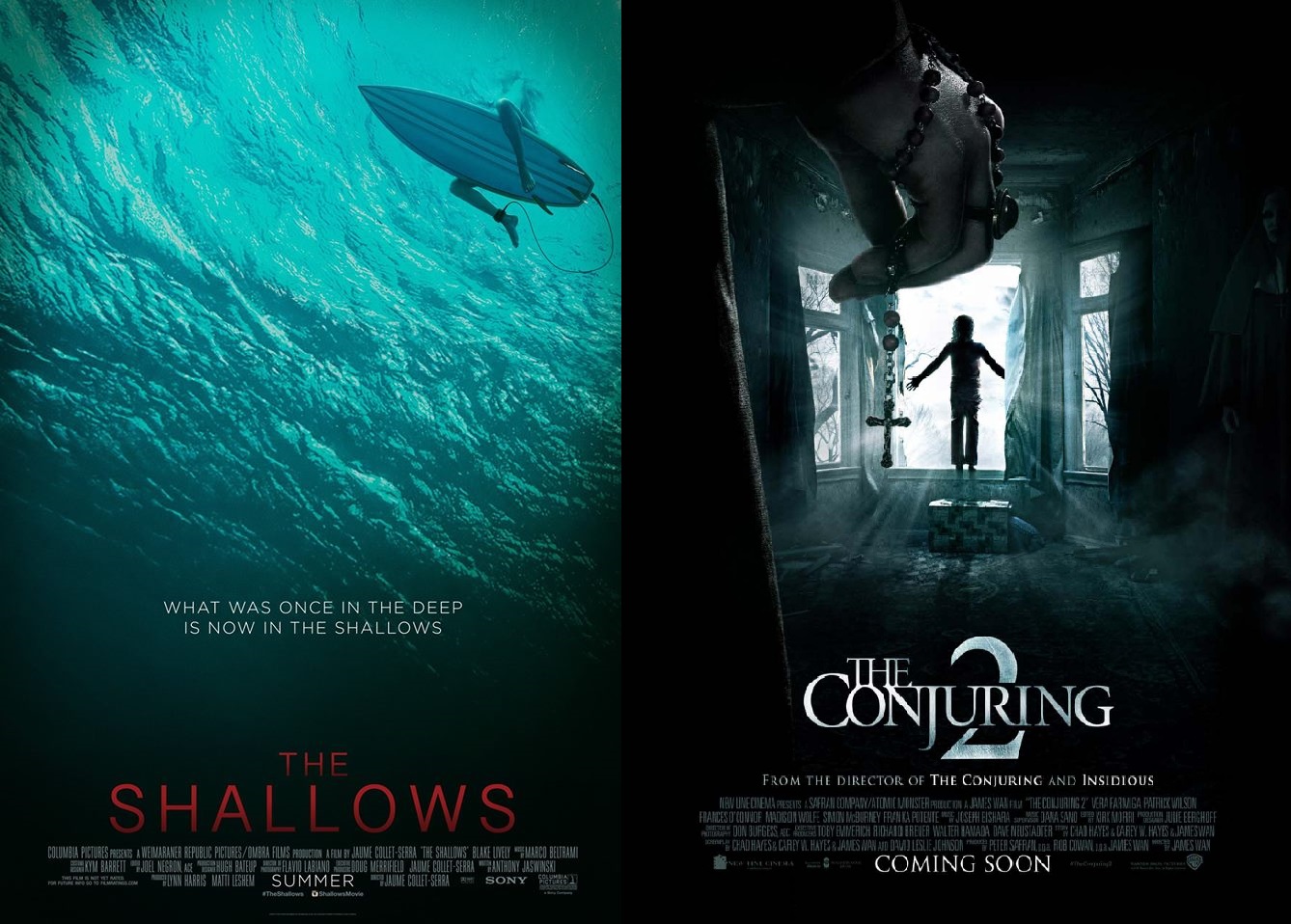
Film Review - THE SHALLOWS and THE CONJURING 2


We’re two months into the summer 2016 movie season and, so far, the narrative has been one of baffling failure, with costly blockbusters (aside from Marvel and Pixar franchises) repelling audiences one after another. But look beyond the gossipy disaster stories and there’s been another trend quietly unfolding, which is the encouraging success of skillfully directed, modestly budgeted horror counter-programming. Both Jaume Collet-Serra’s shark thriller The Shallows and James Wan’s spookhouse extravaganza The Conjuring 2 deliver in spades the type of clever empty calorie thrills and bracing excitement we’ve been conditioned to anticipate from their infinitely more expensive and hyped competition.

As a filmmaker, Collet-Serra isn’t exactly known for his grand auteurist ambition or innovative storytelling. However, previous efforts Orphan and Non-Stop have proven his worth as a peddler of colorful, imaginative and wildly entertaining trash that twists seemingly simple genre set-ups into something weirder and more unique. Consider The Shallows another feather in his slightly askew cap; an immersive single protagonist survival tale that is one of the few killer shark movies to land closer on the quality measuring stick to Jaws than, say, Shark Night 3D.

Headlined by a very game and committed Blake Lively, playing a grieving young surfer held captive a mere 200 feet from shore by an aggressively territorial great white, The Shallows is an impeccably assembled exercise in ever-ratcheting tension. The Barcelona-born director, operating with a mere 17-million-dollar budget, embraces his limitations by keeping his vicious CG co-lead obscured – a sleek, breaking fin here, a murky shadow there – much the way Spielberg so famously did back in the sunny days of 1975. And, similar to that enduring classic, or 2003’s effective Open Water, anxiety is generated by not quite knowing where the marine threat is from moment to moment. As we watch our heroine battle her way through various minor tasks, such as nasty self-surgery or travelling from a floating whale carcass to a sturdier rock, we’re always on edge, waiting for the leviathan to rise up.

Of course, this being a Collet-Serra joint, things invariably get pretty bonkers at a certain point. Although this characteristic descent into cartoonishness doesn’t quite work as well here – due to the stripped down, you-are-there nature of the film – as in past endeavors, his go-for-broke dedication to cheeseball overkill is bizarrely admirable. The man is nothing if not consistent. And if he keeps cranking out B-movie fare this fun, technically proficient and well-acted (even Lively’s avian co-star Steven Seagull turns in a stellar performance), his peculiar brand of high-concept craziness will always be welcome.

While The Shallows helmer has always played on the cheaper end of the studio genre flick system, James Wan – who exploded onto the scene in 2004 with cheapie shocker phenomenon Saw – hasn’t just flirted with the big time, he’s fast become a major player; pulling off Furious 7 with style, despite tragic complications, and signing on to captain DC’s Aquaman. But, watching the frequently terrifying, lovingly crafted sequel to his 2013 smash hit The Conjuring, you sure can tell where his warped heart truly remains. Any hack can create a cheap showcase jump scare for trailers to milk. He digs into this superior follow-up like a man possessed, infusing it with enough feverish, pulse-quickening suspense sequences to fuel over a dozen schlocky one weekend wonders.

Once again drawing inspiration from the true life (entirely bogus) experiences of paranormal investigators Ed and Lorraine Warren (portrayed on celluloid by Patrick Wilson and Vera Farmiga), The Conjuring 2 tremendously fictionalizes the famous events surrounding England’s late 1970s Enfield Poltergeist case. This scenario, which begins with simple bumps in the night tormenting a woman and her four children, before gradually evolving into possession and unthinkable supernatural chaos, affords Wan a wide variety of hellish scenarios to exploit to their profoundly chilling hilt. As mysterious hands push objects out of darkened tents, chairs travel uneasily across rooms and aged specters leer, scream and leave bite marks, you can practically sense the creator grinning sadistically between the frames.

What really makes this franchise work like gangbusters – as opposed to Wan’s two genuinely solid but unremarkable Insidious installments – is the grounding presence of Wilson and Farmiga. They’re so thoughtful, warm and compelling that their very human love story is as involving as the ghastly happenings surrounding them. And because we’re invested in them, and by extension the characters they’re fighting to protect (predominantly Frances O’Connor and talented young Madison Wolfe), the building dread and traumatic frights arrive loaded with an impact that’s surprisingly emotional as well as visceral. The Conjuring 2 again shows Wan to be a formidable master of the form, a ghoulishly ingenious talent rarely better than when he’s dragging unsuspecting ticket-buyers into the horrible recesses of his most hypnotic cinematic nightmares.

The Shallows: 3.5 out of 5
The Conjuring 2: 4 out of 5

Thursday, June 23, 2016

Film Review - FINDING DORY

Pixar has gotten a lot of flak over the last few years for their increased focus on sequelizing their most popular – and *cough* profitable – brands. And yet, with the huge, bold exception of 2011’s running-on-empty Cars 2, the rest have outdone or, at the very least, honored their delightful predecessors. Both Toy Story follow-ups were widely celebrated and embraced by fans, while the underrated Monsters University prequel brought enjoyable new energy, personalities and off-beat humor to the world created by Monsters, Inc.

Finding Dory, the dubious-on-paper extension of 2003’s Finding Nemo, once again proves the studio knows how to milk a property with creative zest, soulfulness and smarts, if a little less richly so than in the past. Returning writer-director Andrew Stanton (who also masterminded Wall-E) knows how to tell an involving tale and deliver the required emotional wallop, and here he ups the ante in terms of ambitious action set-piece staging. And although it’s pretty unlikely many will place this entry above its now classic Best Animated Feature Oscar-winning forebear, it does earn its place next to it on the shelf.

On a visual level, the film is arresting to behold. Vibrant and practically exploding with bright, striking colors Finding Dory captures the same sense of relaxing, tranquil beauty that comes from witnessing the most awe-inspiring of underwater sights. This movie is meant to be seen on the big screen, and it’s also the rare 3D experience that won’t leave you feeling ripped off when you’re tossing your plastic glasses into the recycle bin after the show. There’s an immersive quality to the animation Pixar’s team of artist wizards have accomplished that not only irresistibly draws you into the wondrous setting, but also helps keep your attention rapt during some of the more busy and ultra-cartoony later happenings.

Tugging at the heartstrings right from the get-go, the picture opens with an effective and adorable childhood flashback wherein the short term-memory challenged blue tang (Ellen DeGeneres as adult Dory, Sloane Murray as infant) is separated from her loving parents (Eugene Levy and Diane Keaton) after wandering off on her own. Unable to remember how to get home she embarks on a scattered and lengthy expedition, forced to depend on the kindness of strangers, all the while travelling farther and farther from her destination. This sad, fruitless journey ultimately draws her to the panicked Marlin (Albert Brooks), as he searches for his lost son.

Cut to one year later. Living happily with Marlin and Nemo (Hayden Rolence, replacing Alexander Gould), the plucky and carefree Dory experiences a sudden revelation about the location of her lost parents following a clumsy stingray accident. Dragging her two reluctant pals with her, she ventures to the California-based Marine Life Institute (which has a prominent celebrity spokeswoman!), where injured and sick fish are rehabilitated for release back into the ocean. There she finds an invaluable ally in surly seven-armed octopus “septopus,” Hank (Ed O’Neill, perfectly world-weary), who agrees to help in exchange for assistance in attaining a transfer to permanent aquarium captivity. As the two clownfish attempt to save Dory from herself, she and Hank embark on a chaotic and dangerous odyssey through the park in order to complete her lifelong quest.

Intentionally mirroring their protagonist's brief attention span, Stanton and his co-writers have structured their film with an emphasis on sporadic incident over smooth narrative flow. This approach unquestionably allows for a wider variety of mini-adventures, as both Dory/Hank and Marlin/Nemo head off in different directions, with an abundance of fertile possibilities for comedy and go-for-broke imagination. In addition to Hank’s endless hilarious camouflage demonstrations, there’s also plenty of time for memorable encounters with new series additions such as short-sighted whale shark Destiny (Kaitlin Olson), a pair of hooligan sea lions (reunited The Wire co-stars Idris Elba and Dominic West) and a particularly dim loon named Becky. Also extraordinary is a visit to a fish petting pool that manages to be simultaneously nightmarish and totally side-splitting.

However, Finding Dory’s emphasis on lightning-paced episodic escapades also makes the film feel a bit hurried. Kids will undoubtedly get a rush from its madcap drive, but older viewers may yearn at times for the comparatively more restrained storytelling techniques of superior Pixar efforts such as Up, The Incredibles or Ratatouille. Especially once the genuinely moving tear-jerking developments arrive and it feels like the movie’s nervous about allowing much breathing room for fear of losing momentum.

Because it’s hard, as an adult, to not desire more occasional pauses to appreciate and consider the picture’s compelling and powerful central theme; highlighting the countless challenges placed on those living with special needs. The best section of the film – which belongs in the pantheon of all-time great Pixar achievements – is an extended first-person sequence where a distressed Dory finds herself alone, confused and helpless, and must rely on her own unique coping strategies to talk herself through the situation. It’s scenes like this, as well as the poignant time spent with our heroine and her parents, that reminds us just how magical, essential and matchless the studio can be when they’re firing on all cylinders.

And, frankly, Pixar’s most fearsome competitor at this point – outside of the extremely odd Disney or Dreamworks miracle like Zootopia or How to Train Your Dragon - is themselves. Having created a procession of modern masterpieces they’ve set a bar that’s just not possible to clear every time out. So although Finding Dory only belongs somewhere in the middle of their priceless catalogue, it’s still a sweet, fun and engaging spectacle that enthusiastically swims along in very, very good company.    

3.5 out of 5

Thursday, June 16, 2016

Film Review - WARCRAFT

Is there a more fantasy genre-specific term for technobabble? A term to better describe all the multi-syllable mythical and otherworldly names, places, creatures, weapons and so forth that are endlessly name-checked in streams of incomprehensible dialogue? Fantababble, perhaps? Or magibberish?

That query drifted frequently through my mind while patiently trying to keep up with Warcraft, Duncan Jones’s visually impressive albeit inexplicably impenetrable adaptation of the insanely popular orc-tastic Blizzard video game of the same name. Rarely in history has a tentpole franchise hopeful been so unwelcoming to the general public, burying the unprepared under an increasingly maddening barrage of bewildering exposition that serves only to deepen the frustrating disconnect. This film doesn’t just refuse to give proper bearings; it smashes your movie-going internal compass under the weight of a swinging war hammer.

You almost have to admire the picture’s refusal to cater to non-converts. It’s an undeniably ballsy way to kick-start a 200-million-dollar cinematic property, after all. But this approach – which essentially requires the audience to jump in feet first and just go with the flow - is seriously counterproductive on both a business level (although China doesn’t seem to mind, judging from box-office receipts) and, more importantly, a creative one. If the film can’t plainly communicate to the viewer why the Warcraft universe is cool and original, why would we ever want to see more? And that’s a critical question, given that this inaugural chapter is basically just a confusing cliffhanger prologue to a sequel that will likely never exist.

It’s a bummer, because Jones proved in his first two features, Moon and Source Code, to have a firm grasp on emotionally rich high concept storytelling with a great understanding of character. We were genuinely invested in Sam Rockwell’s lonely space station crisis, and to see Jake Gyllenhaal break free from his inescapable repeating time cycle. The self-described Warcraft fan, who co-scripted with Charles Leavitt (Blood Diamond), seemed like a good bet to wrangle the game’s convoluted lore into a workable, grounded narrative with compelling heroes and villains. Judging from the results, though, the dense material utterly thwarted him.

Based predominantly on the first game entry, Orcs and Humans, Warcraft establishes two adventure plots on an unstoppable collision course. On one side is the brave, noble orc chieftain Durotan (Toby Kebbell), a loving husband and father, who reluctantly joins his horde as they follow demonic lord Gul’dan (Daniel Wu) through a portal bridging their own depleted world to the rich, lush realm of Azeroth. Upon emerging, however, the massive mean green armies fast begin raping and pillaging villages, provoking King Wrynn (Dominic Cooper), on the other side, to assemble a team of fighters – including the poor man’s Aragorn Lothar (Travis Fimmel), guardian wizard Medivh (Ben Foster) and his apprentice Khadgar (Ben Schnetzer) – capable of leading an aggressive defense effort. As the two factions clash, liberated half-breed slave Garona (Paula Patton, in unfortunate 60s Star Trek Orion body-paint) uneasily weighs which side to pledge allegiance to, unaware of the powerful significance she is destined to play in the outcome.

In case it’s not evident in the preceding synopsis, this is pretty broad and colorful fantasy fluff that could easily fuel a really fun and exciting yarn. So why is Warcraft solemn to the point of paralysis? Ever trudging forward with grim self-importance, the film stubbornly avoids almost all semblances of humor (with a couple super lame exceptions) and playfulness and instead delivers a sleepy procession of stilted actors delivering jargon-riddled exposition with all the passion of a live encyclopedia reading. If Lord of the Rings was capable of finding considerable room for high-spirited swashbuckling and light comedy, amidst the suffocating darkness of Frodo’s journey, there’s no excuse for the dearth of it here.
 
With that said, Peter Jackson’s now classic trilogy also understood the importance of engaging personalities with clear motivations. Simply put, almost no one in Warcraft has a logical objective or inner life. And how then are we supposed to care when not a single character sticks after two hours? It’s not fair to blame the actors for being almost uniformly forgettable and/or bland (minus Kebbell, whose solid mo-cap work is nonetheless dwarfed by his far more memorable Dawn of the Planet of the Apes Koba performance), when the screenplay doesn’t give them anything interesting to say and keeps altering their progression to suit the necessities of the fragmented plot. According to reports, Jones was forced to slash about 20 minutes out of the runtime, and it’s obvious; scenes often smash together abruptly with a whole lot of connective tissue seemingly cast into the nether unceremoniously.

For all of its deficiencies as a satisfying summertime blockbuster, though, Warcraft isn’t a painful or unpleasant sit almost solely due to its technical ambition. Jones may not be able to spin an engaging tale to save his life here, yet he’s nonetheless having a total ball with his budget and effects departments. The art direction and costumes are first rate, and the crazy amount of attention paid to world-building is commendable (this is one unapologetically geeky endeavor). Whereas the human stuff is pretty dire, you can tell the helmer’s heart is with the orcs. Each member is impeccably and elaborately designed, and there’s tangible joy every time the hulking giants start pummeling their enemies or one another. Even if the picture doesn’t set any bars with its CG action sequences, there’s more than enough instances of clever and inventive combat staging to meet genre requirements and then some.

Considering the stunningly lousy 23-year-long catalogue of video game movies, it’s regrettable Warcraft, with its boundless resources and behind the camera talent, wasn’t the one to break the mold and prove that a great adaptation is possible. Alas, lacking any real heart, momentum or coherence, it never makes a convincing argument for the brand becoming an ongoing silver screen presence. As for Jones there’s no doubt he still has plenty of magic left in him, but hopefully next time he funnels it into a project that casts a spell of enchantment, as opposed to one of disappointment.

2 out of 5

Thursday, June 09, 2016

Film Review - TEENAGE MUTANT NINJA TURTLES: OUT OF THE SHADOWS

Unlike its noxious sludge-pile predecessor, Teenage Mutant Ninja Turtles: Out of the Shadows can make the proud claim of not being the worst major studio release of its year. A noticeable course correction and casual retconning of the depressingly successful 2014 franchise reimagining, this sequel, directed by David Green, relentlessly pumps the classic animated series nostalgia gas pedal. Not only are Rocksteady and Bebop on hand to rectify the generation-scarring failed promise of 1991’s Secret of the Ooze, so are Krang, Casey Jones, Baxter Stockman, the Technodrome and the Pizza Wagon (*complete with manhole-shooting play action)! It doesn’t add up to much of a movie, but will undoubtedly sell some merchandise. And let’s not pretend the latter achievement wasn’t the primary creative intent.

Once again returning to his powerful producer chair, Michael Bay’s presence can be felt strongly throughout. As far as some of the slick cinematic style and action goes, that isn’t necessarily a bad thing. However, Out of the Shadows also boasts the tedious half-assed and repellent hallmarks of the Transformers franchise (Bumblebee even has a cameo). The plot is seemingly made up after the fact in the editing room, and there’s just enough frat jerk male posturing, awkward misogyny, crass product integration and scatological juvenility to fill out the standard check list. Want to see a giant CG warthog enthusiastically stare down his pants at his altered junk? This is the motion picture for you, my friend!

As Out of the Shadows opens, the now slightly kinder and gentler green machines are suffering serious morale issues. Confined to their underground dwellings, alongside wise sensei Splinter (Peter D. Badalamenti, voice by Tony Shalhoub), they yearn for acceptance from the humans they protect above. While Leonardo (Pete Ploszek – taking over voice duties from Johnny Knoxville) and Donatello (Jeremy Howard) are willing to make the necessary sacrifice, Michelangelo (Noel Fisher) and Raphael (Alan Ritchson) are going stir crazy and fostering growing resentment towards their brothers’ willingness to continue the lonely status quo. 

Crisis brings them back to the surface, though, when April O’Neil (Megan Fox) stumbles across a conspiracy linking TCRI scientist Baxter Stockman (Tyler Perry) to the incarcerated – and inexplicably no longer monstrous and, um, dead - Shredder (Brian Tee, replacing Tohoru Masamune). After the heavily bladed adversary is transported to the mysterious Planet X, during a daring prison convoy escape, he strikes a pact with the slimy, sinister alien Krang (Brad Garrett) to collaborate on a plan for Earthly domination. With a potential doomsday scenario on the horizon, the turtles, April and disgraced corrections officer Casey Jones (Stephen Amell) embark on a dangerous scavenger hunt to track down otherworldly technology that will prevent the invading conqueror from entering their realm. Unfortunately, this task is further complicated by the emergence of Stockman’s lumbering experimental animal/human hybrid warriors; the unstoppable rhino Rocksteady (WWE wrestler Sheamus) and his snorting warthog accomplice Bebop (Gary Anthony Williams).

Among the litany of maddening problems plaguing the previous entry, the most damning was its utter inability to make the title protagonists likeable. Oddly, this had never been the case previously. And although Out of the Shadows hasn’t quite solved the problem it is closer to the right track. The designs are still horrendously unappealing to look at, and they rarely seem to occupy any sort of tangible reality (the movie is so fake-looking it should probably have been 100-percent animated), but the personalities - Donatello in particular - feel more polished, energetic and distinctive. Michelangelo, alas, remains a grating bro-tastic embodiment of Bay-ian id and would benefit from even more toning down. At least Master Splinter no longer looks and behaves like psychotic nightmare fuel, which is nice, and he actually scores a funny or two.

These Poochie-fied versions of the TMNT are again undone by not being grounded by compelling storytelling. Whereas the 1990 film plunked them into an adventure that was fun, lively, and even occasionally emotional, Out of the Shadows writers Josh Applebaum and Andre Nemec strand them in a nonsensical narrative that feels like bad fanboy improv. During Rocksteady and Bebop’s creation we’re informed humans have dormant genes connecting them to various members of the animal kingdom. Sure.
Apparently content to aspire to the base artistic heights of an old Saturday morning cartoon/toy commercial, the movie often lazily tosses out internal logic with the sewer water. Shredder’s abrupt trip to Dimension X unfolds as if crucial footage was lost after production wrapped, for example, and at one point the heroes fly from Brazil to New York seemingly in minutes. Even worse, the all-important McGuffin quest driving the picture feels ripped out of one of Bay’s cruddy Transformers flicks and just consists of characters frantically competing for confusing, vaguely-defined plot points without any momentum or suspense.

The screenplay does correctly place the turtles center stage, though, with Out of the Shadows’ many supporting figures offering distractions generally more appreciated than irritating. Since no actor is capable of delivering a good performance with material this dire, those who camp it up walk away looking the best. Gone Girl scene-stealer Perry’s turn as the loony Stockman almost (Almost!) persuades us into desiring a Baxter-as-fly threequel, and Sheamus and Williams are unexpectedly enjoyable as Rocksteady and Bebop, who are done about as well as one could hope.

Fox’s April is more problematic; the actress has an active non-damsel role with plenty to contribute, yet is alternately presented as shameless eye candy in tight tank tops and, early on, a ludicrous Britney-esque schoolgirl costume. That said she has serviceable chemistry with the amiable Amell - whose convincing physicality helps make up for the fact he’s as edgy as Batman Forever-era Chris O’Donnell – and a mugging Will Arnett as Vernon Fenwick. As a concerned citizen, it’s also my responsibility to note the immeasurably talented Laura Linney shows up as a nosy police chief, possibly against her will. Future viewings will have to determine whether she’s blinking H-E-L-P-M-E in Morse code.

Franchise newcomer Green, despite being saddled with a lost cause screenplay, is still head and shoulders above previous director Jonathan Liebesman as far as colorful visuals go. His early action sequences – predominantly the early truck chase and a wildly over the top race down the river rapids of Brazil – are poppy and engaging, and he’s undeniably strong at staging impact shots ready made for trailers and TV spots. By the time the city-shaking climax hits, however, the helmer is totally overwhelmed, delivering a final battle with Krang (barely a character, sadly) that’s the most fragmented and unsatisfying computer effects-driven finale since last summer’s wretched Fantastic Four.

As disposably inane and hacky as Teenage Mutant Ninja Turtles: Out of the Shadows is, it’s nonetheless undeniably aided by the bottom of the barrel expectations established by part one. Hardcore brand loyalists will eat up the non-stop fan service and likely be willing to overlook the soulless cash-in junkiness and Bay-isms surrounding it. As for the rest of us? Better to write off this broken incarnation and wait for the next mutation. 

1.5 out of 5

Thursday, June 02, 2016

Film Review - X-MEN: APOCALYPSE

Ever since bursting onto the silver screen and ushering in the blockbuster superhero craze in the summer of 2000 Marvel’s X-Men have battled an unending onslaught of formidable and colorful foes. Usually, these battles have generated big thrills for audiences, and allowed the filmmakers to infuse these poppy comic-book morality tales with of-the-moment social commentary and intriguing subtext. X-Men: Apocalypse, on the other hand, delivers a serious game-changer; a big bad who achieves the ghastliest of triumphs in singlehandedly sinking the entire movie around him into a muddy abyss of meaningless mediocrity.

Although it seemed like a promising concept to introduce the hulking blue OG mutant as the primary antagonist for this sixth adventure (even Magneto needs a breather occasionally), in execution the character is a complete and total disaster. Somehow managing to render Oscar Isaac – among the most electrifying actors working today – unwatchable, Apocalypse is an abysmal amalgamation of horrendous makeup work and a total absence of personality, compelling motivation or philosophical interest. And, unlike past lame-duck genre villains like Thor: The Dark World’s Malekith or Amazing Spider-Man’s Lizard, this wheezing gasbag is given copious amounts of screentime to bore fans to sleep with endless ineptly written quasi-mystical monologues. A-Narcolepsy is a more fitting moniker for him.

It shouldn’t have been this way. After Fox drove the franchise off the ever-loving cliff with The Last Stand and X-Men Origins: Wolverine, the one-two punch of Matthew Vaughn’s First Class, and returning series godfather Bryan Singer’s Days of Future Past reignited the brand and opened the door to boundless opportunities. So why does Apocalypse feel so creaky, obligatory and behind the times?

The sad part is it actually starts off well! After an enjoyably goofy flashback involving the entombing of Isaac’s evil En Sabah Nur in ancient Egypt, the picture engagingly bounces around, reintroducing us to the colossal cast and establishing the newbies. Unfolding in an alternate 1983, ten years (?!) after the Sentinel project-thwarting exploits of Days of Future Past, Apocalypse sees the former teammates scattered across the globe. While Professor Xavier (James McAvoy) and Hank McCoy (Nicholas Hoult) focus their efforts on easing the lives of troubled X-kids - such as Sophie Turner’s Jean Grey and Tye Sheridan’s Scott Summers - Mystique (Jennifer Lawrence) has embarked on a solitary stealth war against mutant prejudice and Magneto’s (Michael Fassbender) become a quiet family man in his native Poland.

Fate and superhero movies being what they will, however, things rapidly go awry. Magneto’s peace proves tragically short-lived, fueling a self-destructive quest for revenge. His thirst for vengeance brings him to the attention of the reborn Apocalypse, who enlists him – alongside Storm (Alexandra Shipp), Psylocke (Olivia Munn) and Angel (Ben Hardy) - as one of the Four Horsemen who will aid him in his civilization-ending game plan. After a violent attack on the X-mansion, Xavier and his youthful team, which includes the ultra-popular Quicksilver (Evan Peters) and Nightcrawler (Kodi Smit-McPhee), must band together in order to take down their gravest threat to date.

As amusingly convoluted as these X-film narratives can be, the modest joys offered by Apocalypse come in the table setting and diversions, not the deadly dull central plot. It’s genuinely fun to watch Cyclops’s mini-origin scene where he learns about his powers, or follow along with him, Jean and Nightcrawler as they escape the school to hang out at the mall (and slag Return of the Jedi for being a typical lousy threequel; a swipe aimed at Last Stand but applicable here). The classic Stan Lee or Chris Claremont eras of comic stories always nimbly balanced high-spirited good times with serious gravitas, and Singer – as he did in X-Men and X2- again strikes that right balance with the youth-oriented escapades and the heavier Magneto/Charles/Mystique material. Even an inelegantly cut-and-pasted section featuring a major cameo you can no doubt guess manages to succeed on pure energy despite being almost hilariously pointless.

Unfortunately, just as we’re pulled into the lives of these endearing individuals, the omnipresent threat of Apocalypse keeps rearing its head to suck the life out of the proceedings. Screenwriter Simon Kinberg (Days of Future Past, Fantastic Four 2015) never cracks the character and keeps falling back on repetitive lunk-headed dialogue that throws around weighty terms until its blue in the face (pun intended) without actually adding up to anything substantial or interesting. At one point a TV prominently shows an old Star Trek episode, where the Greek god Apollo is revealed to be an alien who was cast from Earth after humankind no longer needed divinity for inspiration, which appears to hint at the film’s thematic objective but yeegads did it dissipate into nothingness in the transition from conception to reality. So instead we’re left with way too many scenes of Isaac gasping, brooding and staring off into space before the big finale.

Alas, those crossing their fingers for a slam-bang payoff will be disappointed, as the third act is an insufferable disaster. Abandoning all attempts at creating an absorbing conflict, Singer stages a massive multi-mutant war that’s embarrassingly clumsy. Pity this film for opening so shortly after Captain America: Civil War because that smash hit’s unforgettable airport throwdown shows up Apocalypse’s Cairo-set climax six ways from Sunday. As the cast strikes silly poses and wages overly-gymnastic wire-fu combat in front of awful green-screen backdrops, in a sea of glitchy CG swirls and nonsense, it’s hard not to feel sorry for the hours of effort that went into pre-shoot training. The helmer, who actually exhibits technical competence earlier when staging a frenzied cage fight and another show-stopping Quicksilver sequence, bungles moment after moment and fails to grasp any understanding of geography or communicating the basic function of each character within the scene. God only knows what direction poor Michael Fassbender was operating under as he hung from a cable grimly visualizing the hokey 1s and 0s engulfing him.

A strange feature of these pictures has been their ongoing ability to attract stellar talent and then shirk from exploiting it to its fullest potential. McAvoy and Fassbender are again the MVPs, and perform the heavy lifting, yet Apocalypse doesn’t pay off their relationship with the fireworks it demands. Similarly, despite completing a hugely significant arc over three installments, the impact of Mystique’s journey is blunted by Lawrence’s drowsy “Get me outta here!” performance. Of the up-and-coming (read: cheaper) stars Smit-McPhee makes for a fantastically naïve and lovable Nightcrawler, while Turner and Sheridan are charismatic enough to dodge unkind comparisons to Famke Janssen and James Marsden. And, playing the infinitely entertaining Quicksilver, Peters has fast and confidently grown into the franchise’s most invaluable scene-stealer.

This being an X-Men film, though, there’s always a few mutants given frustrating short shrift, with Psylocke, Angel and Storm drawing dead this time around. If you’re not going to develop three of the Four Horsemen, why bother wasting so much time setting them up? Also, Rose Byrne, reprising her First Class Moira Mactaggert role, is a somewhat baffling addition who initially acts as an exposition machine before assuming the position of a glorified background extra once the world needs saving.

Despite Singer and company persistently hyping a seventh installment in this continuity, the stiff and awkward Apocalypse signals a desperate need for reinvention and new creative blood. Being the first of the superhero movie mega-properties, X-Men has earned its rightful place in cinema history and maintained an admirable consistency of vision, even when quality occasionally flagged. Yet with the unconventional Deadpool, and in-development New Mutants, aspiring to make the X-verse fresh and exciting again, these films have sadly lost their formerly unique luster. In short, these mutants need to evolve in order to truly thrive again.

2 out of 5

Thursday, May 26, 2016

Film Review - NEIGHBORS 2: SORORITY RISING

If nothing else, Neighbors 2: Sorority Rising deserves points for having noble intentions. Whereas 2014’s Neighbors used its riotous Yuppies vs Frat Brats premise to explore the dividing line between the recklessness of youth and grown-up responsibility, this second installment has its sights squarely set on the entrenched misogyny of college party culture and the necessity for gender equality. Very timely subject matter, to be sure, and there’s an admirable amount of anger and witty insight contained within the picture’s rat-a-tat joke structure. Alas, despite having its heart firmly in the right place, this second go-round’s laugh ratio is notably reduced from its predecessor, and the freshness has mostly leaked out.

Pardon me if I’m repeating myself, but comedy depends on surprise to succeed. Familiarity is the enemy, as the goal is to constantly catch the audience off guard. This is why so many sequels deliver weary diminished returns. For every A Shot in the Dark, Clerks 2 or 22 Jump Street, which expand and push the property into weird and unexpected places, there are a dozen lame recycle jobs like The Hangover Part II, Horrible Bosses 2 or – God forbid all that is good and holy in the universe – Caddyshack II.

Ultimately, Sorority Rising lands somewhere in the safe, albeit unremarkable, middle ground; it at least offers some funny new gags and ideas. The film also benefits from having great established character dynamics to fall back on. Seth Rogen and Rose Byrne continue to be an infectiously amusing on-screen couple, and they have big time chemistry with Zac Efron’s dim and directionless aging hellraiser. Throw in some shot-in-the-arm supporting parts for favorites Dave Franco, Ike Barinholtz and Carla Gallo and you’re at least guaranteed a pleasant enough time. Is that really enough to warrant the revisit, though?

When we’re reacquainted with Mac and Kelly Radner (Rogen and Byrne), they’re proud, if unrefined, parents on the verge of selling their infamous home. However, as the residence sits in escrow purgatory and the prospective buyers begin assessments, disgruntled college student Shelby (Chloë Grace Moretz) flees the outdated and “rapey” atmosphere of her campus’s frat and sorority scene in order to establish her own female-friendly party house next door. Operating under the dubious mentorship of Efron’s developmentally arrested Teddy Sanders, the girls fast hurl the Radner’s quiet domestic lives into chaos. With their critical real estate transaction on the line, the married pair are forced back to the juvenile front lines once more against an even more resourceful and crafty foe.

Perhaps sensing the lingering threat of sequelitis, returning helmer Nicholas Stoller, who shares screenplay duties with four (!) other writers including Rogen, keeps the energy consistent throughout his picture's brief 92-minute runtime, never letting the occasional dud comic beat disrupt momentum. He also stages some impressively creative and effective setpieces, such as a massive tailgate-party-turned-marijuana-heist sequence (complete with shirtless Efron dance number, for those curious) and a repurposed emergency airbag bit, that nail their intended comedic targets and then some. Stoller doesn’t bring the technical panache of, say, Hangover auteur Todd Phillips, but he continues the strong streak of bouncy workmanlike efficiency he brought to memorable past crowd-pleasers Forgetting Sarah Marshall, Get Him to the Greek and, obviously, Neighbors.

Where Stoller and his team drop the ball, though, is with the new characters. One of the masterstrokes of the first film was creating an authentic connection between the opposing sides and then splintering it. It was fun to watch Rogen and Byrne battle their urge to rebel and be carefree again, and Efron had a compelling arc that ended on an unexpectedly touching resolution. The talented Moretz and her two sidekicks, Kiersey Clemons and Beanie Feldstein, bring everything they’ve got, yet the movie never fashions an interesting relationship between them and the Radners (imagine if the wonderful Byrne had been inspired by their “Girl Power!” call to arms, for example). Instead they’re narratively tied – through credulity-straining circumstances – to Efron’s Teddy and that somewhat unsettling bond just doesn’t gel. And a subplot thematically linking the rambunctious sorority with Mac and Kelly’s parental anxieties about their daughters feels a script pass or two away from working. Had these three actresses, who fight for their right to party with as much comic might as their male counterparts did, been given equally juicy material Neighbors 2 might have been a more valuable endeavor!

Despite its likeable cast, positive messages and occasional glimmers of originality and wit, it’s tough to recommend making the effort to see Neighbors 2: Sorority Rising on the big screen. Back in the golden age of video stores, this would make for primo rental fodder; humorous and breezy enough to entertain, however not substantial enough to feel passionate about one way or another. It all just makes you wish Stoller and his game team of actors had scrapped the easy sequel route and instead dreamed up a new concept genuinely worth running wild and crazy with.

2.5 out of 5