“I’m gonna make some WEIRD shit!” That exclamation, blurted out, eyes agog and mind visibly racing, by Chris Pratt’s ever-ironic Star-Lord shortly after reuniting with his God-like father Ego (Kurt Russell), perfectly sums up the insanely energetic mindset of writer/director James Gunn on his return visit to the Marvel cosmic universe. Following up his surprise smash 2014 origin story, the helmer maniacally kicks into hyperdrive with Guardians of the Galaxy Vol. 2, doubling down on the irreverent hilarity of the first entry and ratcheting up the comic-book crazy to bracingly madcap effect. Remembering when we questioned whether Thor was a step too far for mainstream audiences to accept? Ah, how gently naive we all were.
Whereas the first time around Gunn was bolted down by the now boilerplate Marvel plot structure, complete with a magical item hunt motivated by a vaguely defined villain in Lee Pace’s Ronan, Vol. 2 sees him cutting loose and embracing the groove of his off-beat creation. And, unlike disappointing studio sequels such as Thor: The Dark World and Iron Man 2, the pressure to re-perform doesn’t hobble the movie, it liberates it. Akin to how Captain America: The Winter Soldier evolved from First Avenger, this return of the titular space-faring bad-asses deepens our understanding of the characters and their world, while opening genuinely exciting avenues for future excursions. It leaves one dizzy and salivating for Vol. 3, not brainstorming course corrections.
When we last left Guardians Peter Quill, Gamora (Zoe Saldana), Drax (Dave Bautista), Rocket (Bradley Cooper/Sean Gunn) and Groot (Vin Diesel) they were victoriously blasting off from Xandar in search of “something good, something bad… a bit of both.” They’ve found it, at the beginning of Vol. 2, after valiantly protecting the invaluable battery supply of the aristocratic gold-skinned Sovereign people from a giant slobbering space beastie. However, during the formal process of collecting their reward – Gamora’s evil adopted sister Nebula (Karen Gillen), who has a considerable bounty on her head – unscrupulous mistakes are made and the gang are fast on the run from the planet’s haughty High Priestess Ayesha (Elizabeth Debicki, an ideal blend of camp and self-seriousness) and her army of warships.
During a frenetic escape through an asteroid field, the team encounters Quill’s mysterious biological dad, a celestial being who is in actuality a living, thriving planet. This revelation leads Star-Lord on a quest to learn more about his heritage and his long-lost pa's origins and powers, while Drax bonds with Ego’s gentle companion Mantis (Pom Klementieff), a socially stunted empath with closely kept secrets. In the meantime, Rocket and Groot, with an indignant Nebula in tow, are reunited with disgraced Ravager captain Yondu (Michael Rooker), and get swept up in violent space pirate drama. Ultimately, through shocks and surprises best left unmentioned here, these two engrossing tales intersect in a spectacular climax that delivers a rewarding mega-bomb of character growth and unexpectedly poignant emotional resolution.
For all of its triumphs and indisputable success both commercially and critically, Marvel has long established itself as a producer-controlled brand – not dissimilar from the Bond films under the Broccoli family - where the director’s vision takes a backseat to the grand company plan. And it’s hard to argue with the results for the most part! However, Guardians Vol. 2 feels like the first entry to truly be driven by the sensibilities and obsessions of the auteur behind the wheel. This movie could only have been made by James Gunn, and his peculiar punkish style – honed on several proudly Z-grade Troma productions (including Tromeo and Juliet!), as well as cult faves Slither and Super – is gloriously unleashed across every colorful frame. Striking a perfect balance of off-the-wall and sweet, he bombards the audience with fast-paced bursts of bizarro quips and sight gags, while never allowing the relentless humor to stand in the way of a strong emotional hook. He’s also, of course, a maestro of musical cues, knocking it out of the park again with a killer soundtrack that enlivens the already dynamic proceedings. Sequences set to Fleetwood Mac’s “The Chain” and Jay & the American’s “Come a Little Bit Closer” hit all the right buttons, while the opening credits, featuring Electric Light Orchestra, launch the picture on a perfect crowd-pumping note. And while he lacks the action chops of the Russo Brothers, of Winter Soldier and Civil War fame, he smartly devises clever ways to undercut the more bombastic moments with unexpected reveals or running jokes.
As opposed to Vol. 1, the momentum here feels noticeably far more propelled by the characters than the plot. Frankly, this may just be Marvel’s answer to Howard Hawks’ Rio Bravo; a shaggy hangout film that sets up its story and then sits back and lets its heroes discover their own way to the conclusion, with plenty of amusing diversions along the way. For some this may prove frustrating. But Gunn and his actors understand these heroes and villains so deeply the pace never flags, and we gain priceless insight into their relationships and specific world views. Although the Fast and Furious series superficially crows on and on about the meaning of family, Guardians Vol. 2 is actively intrigued in exploring it, from the off-kilter dynamics between Quill and his dueling dysfunctional father figures Ego and Yondu to the resentful competitiveness dividing Gamora and Nebula. Every major figure has an interesting arc, from MVPs Rocket, baby Groot and Drax (Dave Bautista continues to be a surprising comedy weapon) all the way down to engaging second stringers Ayesha, Mantis and Sean Gunn’s antsy Ravager sidekick Kraglin.
There’s so much unbridled imagination, so much quirky joy running through Guardians of the Galaxy Vol. 2 it often comes across as almost maddeningly effortless. Why can’t more colossal genre blockbusters hit equally rewarding notes or think outside the established boxes?! This is shaping up to be a very special franchise - so far the most confident and consistently winning among Marvel’s slew of very entertaining heavy-hitters – and Gunn leaves little doubt that wherever we find our heroes on their next adventure it thankfully won’t be anywhere safe or predictable.
4 out of 5
Friday, May 19, 2017
Tuesday, March 21, 2017
Film Review - BEAUTY AND THE BEAST (2017)
To compare Walt Disney’s live action Beauty and the Beast remake to its 1991 animated classic predecessor is almost completely pointless. Gary Trousdale and Kirk Wise’s Best Picture-nominated masterpiece is a nearly perfect work that, alongside The Lion King, marks the pinnacle of the company’s Renaissance era. Its haunting, heartfelt and gorgeous artistry forever evolved the form, moved generations of movie-lovers and now occupies the canon of all-time cinema triumphs. Whereas The Jungle Book offered plenty of wiggle room for invention, refining and reinterpretation, no such luck here. And so, rather thanklessly, director Bill Condon’s update of this tale as old as time can aspire only to honor what came before.
Luckily, for the most part this glossy big budget production does. While its reason for existing certainly has far more to do with profit generation than creative ambition, the filmmakers mostly succeed in pulling off the beloved highs and channeling enough of the original’s romantic and idealistic spirit to deliver an appealing old fashioned adventure steeped in new school technology. Whether or not that justifies the effort and countless millions is a question that will likely divide audiences, but there’s still enough novelty here to warrant attention as a modestly enchanting companion piece.
As you’d probably expect, there’s not a lot of variation in the story on this return visit. Belle (Emma Watson) is still a plucky and book-smart heroine, weary of day-to-day life in her “poor provincial town,” who winds up imprisoned in the forgotten castle of the monstrous cursed prince (Dan Stevens) after taking the place of her unlucky inventor father (Kevin Kline). The Beast’s abode is, of course, still occupied by the same gaggle of interfering household items, including Lumière (Ewan McGregor), Cogsworth (Ian McKellan), Chip (Nathan Mack) and Mrs. Potts (Emma Thompson), who enthusiastically adopt the role of matchmakers in order to break the spell that has altered them. Villainy is supplied once again by the narcissistic creep Gaston (Luke Evans), a boastful war hero with anger issues, and his simpering, visibly lovelorn cohort LeFou (Josh Gad, camping it up with wild abandon).
To be fair, though, the script, by Stephen Chbosky (The Perks of Being a Wallflower) and Evan Spiliotopoulos (The Huntsman: Winter’s War), doesn’t completely follow Linda Woolverton’s original screenplay – how it isn’t credited as source material is still a mite baffling - verbatim. Beauty and the Beast 2017 pleasantly expands on the courtship between the two confused prospective lovers, such as a nice addition wherein her passion for Shakespeare inspires him to call upon his own invaluable aristocratic education, and deepens the sadism and manipulative tendencies of Evans’ blustering antagonist. Unfortunately, they also graft a thoroughly unnecessary subplot regarding the Beast and Belle’s mothers onto the picture, the latter of which sticks out like a jarring sore thumb thanks to its too grim tone and a lazy throwaway plot device gimmick. At 129 minutes, tacked on material like this, a hacky and simplistic attempt to ground the characters’ psychology and give them a common bond, only takes up time with zero emotional reward.
Alas, it’s a bit of a damning testament that, more often than not, it is the new material that brings this Beauty and the Beast to a screeching halt, especially given the flawless economical storytelling of the 1991 film. Thankfully Condon, whose diverse and slightly batty resume, which includes entries like Kinsey, Dreamgirls and the two Twilight Saga: Breaking Dawn installments, implicitly understands what he’s selling tickets for. He stages the cherished Alan Menken/Howard Ashman musical numbers with a showman’s splashy aplomb (soaring opener “Belle” and the eternally chill-inducing title number are the most dazzling showstoppers), and even gives Beast a grandly tormented torch song of his own. And despite having the impossible task of creating visual splendor on par with Disney animation at its best, he and his art department blanket the screen with stylishly melancholy gothic atmosphere, complete with perpetual snowfall and crumbling stone architecture with a groaning pulse of its own. Echoes can often be felt of Jean Cocteau’s hypnotic 1946 version of the fairy tale.
Condon and his team deserve credit for the technical polish of this Beauty and the Beast, which is more of a sumptuous visual extravaganza than Maleficent, the Alice in Wonderland movies or Kenneth Branagh’s otherwise superior Cinderella. They’re so good at adapting the unforgettable iconography of the original that’s it’s easy to take for granted, as the parts that stumble stand out more than the countless elements that don't. Yet, it must be said, the Beast’s transformed servants simply don’t work when grounded in our physical reality. Their stiff, busy designs lack charisma and never achieve the larger than life presence of their more colorful counterparts. This deficiency is most felt in the huge “Be Our Guest” sequence, which the director goes for broke with, but is drained of life and charm thanks to its performers’ lack of broadly exaggerated body language and expressive facial gestures. It’s easy to see why the filmmakers didn’t bother to include the song “Human Again,” which was added for the original’s 2002 re-release.
Despite all the shiny bells and whistles, all would be for naught if the performances fell flat. And, thankfully, they're almost all uniformly winning. Watson cheerfully radiates Belle's proud, inquisitive confidence, and knows exactly how to sell the pure wide-eyed wonder of a Disney heroine. She generates strong sparks with Stevens’ poignantly mournful mo-capped Beast, who’s noticeably less animalistic than Robby Benson’s, and has gentle chemistry with the always reliable Kline. Perhaps unsurprisingly, though, it’s Evans’ Gaston who steals the show! The actor, often cast in underwritten roles like the title bloodsucker in Dracula Untold and as the baddie of Fast & Furious 6, must have known he had landed an ideal showcase and attacks it with the ferocity of a pack of ravenous white wolves. He exhibits all the cartoonish, clueless vanity you’d hope (the “Gaston” performance doesn’t disappoint), with unsettling layers of intense psychological weirdness bubbling underneath.
With a flurry of live action Disney reinterpretations in the works – including The Lion King, Mulan, Fantasia’s “Night on Bald Mountain,” Peter Pan and *ahem* Dumbo – it’s tough to view this Beauty and the Beast as something that's overly special. However it’s a solidly transporting family entertainment that effectively taps into the audience’s profoundly powerful nostalgia for the 1991 film. This is skillful studio moviemaking, featuring many of the industry’s finest craftspeople working with ungodly resources to realize their vision. It just never convinces us into believing we’re watching magic.
3 out of 5
Thursday, February 02, 2017
Film Review - XXX: THE RETURN OF XANDER CAGE
It’s safe to say the world didn’t need another sequel to XXX, nor did it probably want one. After all, the novelty of watching an extreme sports spy adventure wore off about 45 minutes into the thuddingly bland 2002 original. So why does The Return of Xander Cage exist then, you ask? Well, based purely on the evidence at hand, it exists entirely to serve as a big dumb tribute to the glowing majesty of Vin Diesel. For this movie argues the 49-year-old action star (who also produced) is both our greatest living athlete and a breathtaking specimen of pure perfection. Oh, and he’s utterly irresistible to all women, despite the fact the film’s love scenes have about as much carnal passion and raw sexuality as the famous Seinfeld bit where Kramer makes out with an Elaine mannequin. I’ll leave it to you to determine who the mannequin in this equation is. To be fair, Diesel in midlife crisis mode still usually works. But does it work here? Not so much, sadly. The problem really lies in the fact that, whereas the star’s Fast and Furious franchise has matured and evolved with the times, the XXX series has not. Yes, the family theme has been majorly boosted, with an appealingly diverse, albeit hit-or-miss, supporting cast put in place, yet the movie itself feels like a B-level effort from the last decade. The dialogue and scripting by F. Scott Frazier is flat at best, groan-inducing and dimly misogynistic at worst, and there’s not much wit or imagination to make up for the overwhelming lunk-headedness of the entire endeavor. If you’re not going to push the insanity of the dopey premise to feverishly crazy places, why really bother?
The Return of Xander Cage does raise hopes in its early moments, though, as we’re introduced to its apparent antagonists; a badass parkouring quartet of wild cards (Donnie Yen, Deepika Padukone, Tony Jaa and Michael Bisping) who crash CIA headquarters in order to steal an electronic gadget called Pandora’s Box. What is this all-important McGuffin, pray tell? It’s a handheld electronic device capable of bringing down satellites like guided missiles. All that really matters, however, is that CIA head honcho Jane Marke (Toni Collette, camping it up like a true pro) wants it back and recognizes there’s only one man capable of retrieving it.
She finds our tattooed savior in Latin America, where he’s performing Robin Hood-like feats for local villages using little more than a skateboard and, uh, snow skis. Although reluctant to re-align with the government, Cage ultimately enlists, bringing with him an alternative-styled squad of his own: sharpshooter Ruby Rose, madman driver Rory McCann, nerdy techie Nina Dobrev and rave DJ (yes, you read that correctly) Kris Wu. While the mission seems pretty straight forward at first, it’s isn’t long before the two opposing sides’ relentless series of stunt spectaculars and acrobatic displays of hyperkinetic fisticuffs give way to the staggering revelation there could be more going on than they initially realized. Gadzooks!
Unlike Rob Cohen’s series opener, or Lee Tamahori’s deservedly forgotten Ice Cube-led sequel State of the Union, The Return of Xander Cage actually manages to deliver a memorable action beat or two. The showcase sequences, such as Diesel’s aforementioned jungle skiing/skateboarding getaway, and a massive ocean-bound motorcycle chase between him and Yen, are cleanly staged by director D.J. Caruso (Eagle Eye) – who was previously notorious for his over-frenzied and incoherent on-screen action – and don’t suffer from the cartoony CG overload that occasionally sneaks in to the later bits. Sure, their overt goofiness detracts from any potential exhilaration, nevertheless they’re different and represent the film’s rare willingness to think outside the box. And it’s impossible to ignore the fact they all occur in the first half, leaving a second hour that relies far more on boring shoot-outs and passably-shot brawling. The climax, aboard a jumbo jet, offers some fun ideas without ever quite delivering the knock out we hope for.
Whereas Diesel’s engaging credibility as a physical presence is indisputable, he lacks the light touch charisma to really pull off this breed of character. He’s better at playing more emotionally burdened figures like Dom Toretto or Riddick, where his rumbling vocal affectations and tortured moodiness tap into a certain poetic tough guy gravitas. Xander Cage lacks those qualities, and relies more on playful flash and verve to get by. The actor does what he can with very dated material, firing off terrible puns and dire jokes dutifully, but never truly commands the screen like he should. Instead of being the magnetic anchor the movie needs, like spiritual predecessor James Bond, he’s often totally overshadowed by more compelling players like Yen, Collette, Samuel L. Jackson or his absurdly fluffy coat.
Unlike 2011’s fantastically amusing Fast Five, XXX: The Return of Xander Cage fails to succeed in its bid to persuade us this is a Diesel franchise in need of a renaissance. Back in 2002 the first entry attempted to advertise to the world that Bond was a tired relic in need of a more youthful and edgier replacement, and now we have a third sequel that seems to unconsciously aspire to ape the final Pierce Brosnan 007 film Die Another Day. That ain’t progress and it sure isn’t relevant, no matter how much hip hop music you add to the mix.
2 out of 5
Thursday, January 26, 2017
Film Review - THE FOUNDER
As an actor, Michael Keaton is unable to mask his razor-sharp intellect. There’s a nervous, fidgety energy about him, a sense that he’s always working angles in his head. We always suspect he’s a step or two ahead of those around him, and that he’s consistently engaged by his secret determination to remain so. His best films, such as Tim Burton’s Batman entries, Beetlejuice, Spotlight, The Paper or Jackie Brown, tap into the live-wire eccentricity hidden beneath his everyman exterior and burst to life whenever he so much as raises his cocksure, devilish eyebrows.
It’s been great fun watching Hollywood rediscover him the last few years, beginning with the best picture-winning Birdman, and it’s a pleasure to see him land another perfect gig in The Founder, John Lee Hancock’s amusing biopic of wily McDonald’s visionary Ray Kroc. Opening in the mid-1950s, the movie chronicles the unlikely windfall of Keaton’s fast-talking-yet-floundering milkshake salesman after he stumbles upon a novel California eatery that serves up hot burgers while you wait. Instantly enamored with the joint, and its inventive behind-the-counter operations, he talks himself into a partnership with naïve owners Dick and Mac McDonald (Nick Offerman and John Carroll Lynch), and quickly focuses on blowing up the brothers' proud brand through franchising. Soon, however, Ray’s insecurities and ruthless, desperate ambitions bring him into conflict with his unsuspecting new partners, birthing an ugly war for ownership of the fledgling fast food empire.
While the notion of a McDonald’s origin story may not seem like the most tantalizing of creative endeavors, it’s an ideal project for director Hancock. Since making his helming debut with the 2002 baseball drama The Rookie, he’s shown a unique passion for exploring classic American institutions, from 2004’s The Alamo, to football (The Blind Side) and Disney (Saving Mr. Banks). And while he undeniably lacks the incisive, merciless bite of a true cultural critic, he’s a charming, breezy
filmmaker with a knack for crafting smart, pleasantly involving historical recreations that play well to mainstream audiences.

filmmaker with a knack for crafting smart, pleasantly involving historical recreations that play well to mainstream audiences.

The Founder is no different, albeit with a more pessimistic edge thanks to Keaton’s unrepentant protagonist. And although Hancock doesn’t totally villainize Kroc – the movie leaves little doubt that his shameless self-promotion, go-for-broke investments and shady business tactics were crucial in propagating the McDonald’s name – it also doesn’t try to paint him as a misunderstood hero or unorthodox champion of the glorious American dream. No, as portrayed he’s an undeniable selfish bastard, dismissive of his weary supportive wife (an underused Laura Dern), and calculated in his efforts to exploit family values and community pride in order to sell cheap artery-clogging food. It’s too bad the script, by Robert Siegel (The Wrestler, Big Fan), wasn’t a little bit meaner, or interested in really delving into the relentless psychology that drove its subject. As entertaining as the picture is, it’s a little disappointing it never quite strives for the same deep dive analysis as Aaron Sorkin’s not dissimilarThe Social Network or Steve Jobs screenplays.
Even if the film’s aspirations are a bit artistically modest, Keaton has rarely been more committed. Speaking in a rat-a-tat Midwestern accent, and grinning like the Cheshire Cat, the actor explodes with over-compensating self-assurance. Whether unloading aggressively cheesy salesman patter directly into the camera, or shooting condescending barbs at Offerman and Lynch’s endearingly sympathetic, yet hopelessly out-of-their-depth, entrepreneurs, it’s a big, showy Movie Star© performance that skillfully propels the narrative and makes even the more mundane inside baseball dealings intriguing. This cinematic version of Kroc is the only guy in the room who truly knows the score, so it’s fitting that the solid supporting players, including Patrick Wilson, Linda Cardellini and an icy B.J. Novak, always seem to be orbiting him without ever quite stealing away the spotlight.

Watching our lead scheme and manipulate his way into fame and fortune at the expense of his innovative, hard-working colleagues, it’s impossible to ignore The Founder’s regrettably timely and relevant message. Hancock may not break much new ground in telling this very familiar story, but it’s well-acted and highly effective at communicating the ins and outs of McDonald’s journey towards global juggernaut status. And in Keaton’s Ray Kroc, we have a compelling embodiment of crass capitalist opportunism run amuck. Even if we don't necessarily need more of those right now.

Watching our lead scheme and manipulate his way into fame and fortune at the expense of his innovative, hard-working colleagues, it’s impossible to ignore The Founder’s regrettably timely and relevant message. Hancock may not break much new ground in telling this very familiar story, but it’s well-acted and highly effective at communicating the ins and outs of McDonald’s journey towards global juggernaut status. And in Keaton’s Ray Kroc, we have a compelling embodiment of crass capitalist opportunism run amuck. Even if we don't necessarily need more of those right now.
3.5 out of 5
Friday, January 13, 2017
The Bottom 5 Worst Films of 2016
1) 31 – What in the name of batty ol’ Beelzebub has happened to Rob Zombie? Once considered one of horror’s most terrifically twisted and offbeat rising stars, he’s been on a depressing downward spiral ever since regrettably rebooting Halloween. His latest, the completely and hopelessly incompetent 31 – a dim-bulb film school student’s gore-streaked redneck take on The Running Man or Hunger Games – is awful to the point of being nigh unreleasable. The story, involving a team of carnies forced to survive an underground battle royale against grease-painted psychopaths (headed by a chilling Richard Brake), is merely a lazy excuse for Zombie to shamelessly resurrect ideas from superior past efforts like House of 1000 Corpses and The Devil’s Rejects. Devoid of even a faint glimmer of directorial ingenuity, 31 is little more than a crushingly tedious clown show.
3) INFERNO – Say what you will about the previous Robert Langdon adaptations, they didn’t feel like the principal creative team was just phoning it in. Such is not the case with Inferno, the shambling Dante and Botticelli-themed artifact-chase starring Tom Hanks and Felicity Jones, which feels like it was assembled with all the passion of a 1990s Time Life books infomercial. Scattershot, artistically apathetic and talky to the point of inspiring the viewer to feverishly daydream about better movies they could be watching, Ron Howard’s third time at bat left zero doubt it’s time for the Dan Brown cinematic universe to be ingloriously left to gather dust for the foreseeable future.
5) BLAIR WITCH – As the ageless expression goes, those who don’t learn from history are doomed to repeat it. Apparently the usually dependable duo of director Adam Wingard and writer Simon Barrett, who previously spawned The Guest and You’re Next, didn’t pay close enough attention to the universal disinterest in 2000’s Book of Shadows: Blair Witch 2. Maybe if they had, they wouldn’t have wasted their precious time cranking out this hacky found footage stinker, which mostly just rips off the zeitgeist-tapping 1999 surprise smash with far more screeching noise, cheap jump scares and braindead character decisions. Fittingly, however, audiences warded off the spell of Blair Witch, which became the lowest grossing installment yet, even after 16 years of ticket price inflation. Eek!
2) ALICE THROUGH THE LOOKING GLASS – Disney may have posted record-breaking profits and released some great entertainments in 2016, but it wasn’t all sunshine and roses for them. Nope, the Mouse House also churned out this totally unnecessary and grating cash-grab bomb, which vomits forth flatlining origin stories for the Red and White Queen (Helena Bonham Carter and Anne Hathaway) and Johnny Depp’s lisping dandy Mad Hatter. Mistaking ugly cyclones of crappy CG and seemingly improvised plotting for charm and whimsy, James Bobbin’s Alice through the Looking Glass makes its mediocre Tim Burton-directed predecessor look like a shining model of inspired cinematic magic for the ages. Tragically, the only legacy this shrill debacle seems destined to leave is being the tragic answer to the trivia question: “What was celebrated actor Alan Rickman’s final movie role?”
3) INFERNO – Say what you will about the previous Robert Langdon adaptations, they didn’t feel like the principal creative team was just phoning it in. Such is not the case with Inferno, the shambling Dante and Botticelli-themed artifact-chase starring Tom Hanks and Felicity Jones, which feels like it was assembled with all the passion of a 1990s Time Life books infomercial. Scattershot, artistically apathetic and talky to the point of inspiring the viewer to feverishly daydream about better movies they could be watching, Ron Howard’s third time at bat left zero doubt it’s time for the Dan Brown cinematic universe to be ingloriously left to gather dust for the foreseeable future.
4) COLLATERAL BEAUTY – Will Smith really, really needs to stay away from naked high concept Oscar grabs. You’d think he’d have learned his lesson after 2008’s legendarily ridiculous Seven Pounds, which featured an unforgettably bizarre supporting turn by a jellyfish. But no, he only pushed the envelope further in 2016 by appearing in this astonishingly ill-conceived drama about a near-suicidal ad exec whose best friends use elaborate manipulation to convince his company’s board of directors he’s insane following his daughter’s untimely death. And if that sounds utterly reprehensible, the film sure doesn’t seem to know it! Directed with insultingly synthetic feel-good smarminess by The Devil Wears Prada’s David Frankel, Collateral Beauty wastes its all-star cast on an unsalvageable, laughably convoluted story that can’t even coherently explain the meaning of its own unwieldy title.
5) BLAIR WITCH – As the ageless expression goes, those who don’t learn from history are doomed to repeat it. Apparently the usually dependable duo of director Adam Wingard and writer Simon Barrett, who previously spawned The Guest and You’re Next, didn’t pay close enough attention to the universal disinterest in 2000’s Book of Shadows: Blair Witch 2. Maybe if they had, they wouldn’t have wasted their precious time cranking out this hacky found footage stinker, which mostly just rips off the zeitgeist-tapping 1999 surprise smash with far more screeching noise, cheap jump scares and braindead character decisions. Fittingly, however, audiences warded off the spell of Blair Witch, which became the lowest grossing installment yet, even after 16 years of ticket price inflation. Eek!
Dishonorable Mentions: BATMAN V SUPERMAN: DAWN OF JUSTICE, GODS OF EGYPT, INDEPENDENCE DAY: RESURGENCE, TEENAGE MUTANT NINJA TURTLES: OUT OF THE SHADOWS, WARCRAFT
Tuesday, January 10, 2017
The Top 10 Best Films of 2016
1) SING STREET – 2016 probably won’t go down in the history books as one of mankind’s proudest years. And yet, amidst all the cynicism and bad news, this unassuming little Irish musical from Once director John Carney emerged, utterly exploding with wide-eyed optimism, exhilaration and unbridled joy. An enchanting coming of age yarn about a teenage musician’s awkward artistic awakening, Sing Street boasts a terrific, disarming cast (Jack Reynor, as our hero’s slacker brother, is a star in the making), huge fist-pumping underdog story highs and an infectious all-timer soundtrack loaded with rousing earworm confections. Although there were several remarkably moving films released in the past twelve months, none matched this charmer’s gift for leaving the viewer beaming ear to ear, ready to take on the world no matter the obstacles.
2) MOONLIGHT – No doubt about it, Barry Jenkins’ enthralling coming of age triptych chronicling the development of a young gay black man in the slums of Miami was the most beautifully compassionate and deeply human cinematic work of 2016. Utilizing its protagonist’s specific journey to tap into countless universal truths, Moonlight never falls prey to artifice, cliché or cheap sentiment. No, rather it achieves something far more powerful and pure: catharsis. Populated by a wonderful ensemble – with towering stand-out turns by Mahershala Ali and Naomie Harris – this is an utter miracle of a movie, humble in its intentions but genuinely enriching for the soul.
3) MANCHESTER BY THE SEA – Casey Affleck’s been building up steam for quite some time, amassing an impressive number of sensational performances in predominantly independent fare. Here, in Kenneth Lonergan’s audacious examination of the messy grieving process, he at last earns his place among our current acting titans playing a directionless loner forced to return to his home town to care for his teenage nephew – played by extremely promising newcomer Ben O’Brien - after his brother passes. Keenly observant, raw and frequently funny (no, seriously!), Manchester by the Sea is an intensely touching account of a damaged man waging an exhausting daily battle to come to terms with the wreckage of his past.
4) NOCTURNAL ANIMALS – Fashion designer extraordinaire Tom Ford’s wrenching sophomore directorial effort is brutal, unforgettable proof that he’s the real deal. A combustible cocktail of cinematic influences - including Lynch, De Palma, Hitchcock and the Coens - Nocturnal Animals feverishly mashes up Cormac McCarthy-esque neo-western fatalism with despairing upper class ennui to uniquely jaw-dropping results. Unfolding over two parallel tales – one in the real world occupied by Amy Adams’ unsatisfied gallerist, the other a fictional narrative involving Jake Gyllenhaal and a wry lawman played by the brilliant Michael Shannon – that slyly comment on one another, the film sees Ford playing the audience like a piano, masterfully controlling tension and leaving you dazed, captivated and out of breath.
5) CAPTAIN AMERICA: CIVIL WAR – Never satisfied to rest on its laurels, the Marvel movie machine’s thirteenth (!) production was its best yet; a classic clash of compelling crime-fighting ideals that’s as interested in colorful character psychology as pyrotechnics. Nimbly accommodating a veritable army of all-star icons, including headliners Cap and Iron Man, as well as insect-themed scene-stealers Spider-Man and Ant-Man, Civil War is pure blockbuster bliss fueled by its makers’ unabashed adoration for their vibrant comic-book universe. After seeing similar material done horrendously wrong the same year by the noxious Batman v Superman, this third Captain America adventure once again saw the House of M confidently reminding the world that when it comes to superhero cinema nobody does it better than them.
6) ARRIVAL – It’s so rare to encounter a science fiction film that feels truly original and authentic that when it happens it’s impossible not to be swept up in a feeling of revelation. Such was the case with Denis Villeneuve’s brainy and unexpectedly poignant first contact story featuring Amy Adams as a linguistics expert struggling to decode a daunting extraterrestrial language against a volatile political ticking clock. An expertly scripted adaptation of Ted Chiang’s “Story of Your Life,” Arrival offers a potent blend of engrossing intellectual curiosity and profoundly moving emotional fireworks, and is all but guaranteed for genre canonization in the years to come.

7) ZOOTOPIA – Continuing its astounding recent animation hot streak, Disney’s hilarious, sincere and surprisingly sophisticated take on the buddy cop genre doesn’t just cheekily tweak the genre; it also manages to be a clever and involving entry in it as well. Buoyed by winningly multi-dimensional heroes, energetic world-building, laugh out loud gags (the much-hyped sloth scene is bonafide comedic genius) and a message that, sadly, couldn’t be any more relevant, Zootopia represented the best in family entertainment in 2016. Forget Frozen 2, get Judy Hopps and Nick Wilde back on another case, and pronto!
8) LA LA LAND – After 2014’s astonishing Whiplash, helmer Damien Chazelle became one of the most encouraging rising talents in the industry. Even still, though, it’s more than a little dumb-founding how effortlessly playful and graceful this delightful Singin’ in the Rain-inspired musical odyssey feels under his assured guidance. From its bouncy opening freeway dance off, to the magical, wistful final reverie experienced by irresistible leads Ryan Gosling and Emma Stone, La La Land both sweetly honors the traditions and conventions of classic Hollywood song and dance pictures and delicately hits all the right heartfelt notes a modern audience would hope for.
9) THE NEON DEMON – A bracing and sobering antidote to La La Land’s dreamy sun-soaked look at the City of Angels, uncompromising auteur Nicolas Winding Refn’s fashion world grotesque-a-thon is one sick and twisted wake up call. Starring a naively innocent Elle Fanning as an aspiring model grasping at fame while triggering predatory instincts in those around her, The Neon Demon takes the director’s repulsively gorgeous brand of synthetic hallucinatory pop filmmaking to its most unsettling conclusion. Thrilling, dazzling and icy, it’s a spellbinder that writhes and sways to its own haunting rhythms, the hell with the consequences.
10) ROGUE ONE: A STAR WARS STORY – Rarely ever before has calculated franchise retconning been this inventive or exciting! Gareth Edwards’ kinetic prequel to A New Hope does exactly what it should; expanding the Star Wars universe in fresh and interesting ways, adding appreciated shades of grey to its typically black and white morality and delivering wonderfully grand big screen spectacle. The first real examination of war in the series, Rogue One exploits its “men on a mission” formula to spectacular effect, considering the human cost in a series that previously rarely slowed down long enough to do so. By the time the epic slam-bang final act comes to its triumphant conclusion there’s little doubt the force is still very, very strong.
Honorable Mentions: DE PALMA, THE EDGE OF SEVENTEEN, EVERYBODY WANTS SOME!!, FENCES, PETE’S DRAGON, THE WITCH
Tuesday, August 16, 2016
Film Review - SUICIDE SQUAD
Back in May Marvel proved with Captain America: Civil War it could skillfully juggle over a dozen major characters without sacrificing storytelling clarity and intelligence. On the flip side, Suicide Squad - Warner Bros. third entry in its increasingly distressing DC Universe mega-franchise – fails miserably to coherently portray its leads’ journey on foot across a few city blocks. This is sadly becoming par for the course for the studio, who have this time assembled a fun, colorful, well-cast batch of antiheroes and tossed them into a tornado of sloppy, shapeless narrative chaos. Like Batman v Superman, this film is so desperate to set up future sequels and spin-offs it furiously forsakes its own enjoyment and overall worth.
There’s a kernel of splashy Dirty Dozen-esque genius to the Suicide Squad concept – wherein a taskforce of homicidal marquee supervillains are forcibly drafted into an unwinnable battle – that screams cool. It’s a twist on the comic book picture we haven’t seen on screen yet, and bolstered by endless resources to achieve its wildest ambitions. Too bad, then, this movie’s feverish imagination mostly begins and ends with its flashy, gaudy costuming and temporary tattoo budget. If ever there was an opportunity to embrace the crazy this was it! Did we really need another generic “Stop the boring, vaguely defined villain from opening a sky portal!” story conveyed with all the live-wire energy of Batman doing an open mic night comedy routine?
Speaking of ‘ol Bats, it’s no coincidence popular members of his legendary rogues gallery dominate, with assassin extraordinaire Deadshot (Will Smith) and vicious vixen Harley Quinn (Margot Robbie) sharing the limelight, and the Joker (Jared Leto) periodically popping in from another (hopefully better) movie to boost marketability. The film makes zero effort to convince us they’re on equal footing with their dastardly supporting colleagues, who run the gamut from mildly amusing cartoons – Aussie safe-cracker Boomerang (Jai Courtney), fire-shooting Diablo (Jay Hernandez) and sewer-dwelling reptile Killer Croc (Adewale Akinnuoye-Agbaje) – to bland half-finished sketches. No doubt team leader Rick Flagg (Joel Kinnaman), Enchantress (Cara Delevingne) and Katana (Karen Fukuhara) are fascinating on the page, but here? Not so much. And what’s the deal with Slipknot? Adam Beach’s baddie appears to have been purposely edited out almost entirely, indifferently announced mid-picture with a hilariously speedy bit of dialogue blatantly pasted in during post-production.
So why has this insanely dangerous collection of psychopathic criminals with greatly varying abilities and powers been let out of their maximum security prison cells? Because fearsome government agency head Amanda Waller (Viola Davis, voraciously chewing scenery and spitting out exposition with grim purpose) believes America needs a secret weapon to thwart the potential threat of a Superman gone awry. However, just as her initiative is uneasily approved, vengeful eons-old witch Enchantress - who has body-snatched innocent archaeologist June Moone - escapes and awakens her unstoppable brother Incubus in order to destroy humanity. With the apocalypse fast dawning, Moone’s disgraced soldier lover Rick Flagg is forced into action alongside his disposable “suicide squad,” who are equipped with failsafe explosive devices and more than a little resentful about it. And, if the world being turned into a smoking husk wasn’t enough, ultimate wild card Joker devilishly schemes to free deranged girlfriend Harley from the clutches of justice.
One can be wholly forgiven for expecting Suicide Squad to be brimming with confidence. Lord knows, the omnipresent advertising campaign has projected nothing but! In reality, though, the film – which was written and directed by End of Watch and Fury auteur David Ayer – clearly isn’t. At all. Over-edited and reshot to death, the finished product bares the sweaty handprints of countless execs terrified of dropping the ball in the wake of Batman v Superman. Characters are introduced multiple times, vanish completely from the picture only to reappear without mention, and are given big climactic emotional beats that land with a thud due to their arcs being cut to shreds. The sporadically engaging first act is almost daringly unhinged; an extended series of mostly disconnected montages scored to a parade of idiosyncratic song choices, hastily scotch-taped together by Viola Davis voiceover. It’s something to behold certainly, and at least hints at a level of manic weirdness that never arrives once the central plot kicks in.
Given how visibly compromised Suicide Squad is it’s not fair to solely blame Ayer for how rudderless and incomprehensible the whole endeavor is. The film can’t even properly explain why Amanda Waller would form the group, given she’s friendly with Bruce Wayne (Ben Affleck) and other formidable heroes are shown to be active. More frustrating is the complete lack of tension and momentum in the plot. There’s no ticking clock and no compelling stakes to drive our antagonistic protagonists forward. You can feel the energy slacken as they wander aimlessly from one uninteresting fight scene to another without a clear mission objective, occasionally interrupted by talky diversions and unnecessary Joker business (the majority of Leto’s scenes as the Clown Prince of Crime – now a glitzy, angsty Scarface-wannabe who’s too silly to be scary – could be easily removed with no ill effect).
And yet, despite being a superhero spectacle lost cause, Suicide Squad gets two things very, very right; Deadshot and Harley Quinn. Every time Smith and the show-stopping Robbie – whose unqualified success as the fan fave villainess is slightly complicated by Ayer’s long-established misogynistic male gaze – are on screen we’re reminded we are in the presence of true movie stars. In a film over-burdened with dumb, empty posturing, they’re triumphant, exciting and hugely charismatic comic book translations that beg to be featured in a project deserving of their gifts. It’s a hoot to see them overshadow their underwritten co-stars and tangle (all-too-briefly) with Affleck’s Batman! Stop mucking about DC and get it done and done properly!

Problem is Warner Bros. and DC aren’t exhibiting much interest in cultivating well-crafted star vehicles for their rich staple of icons the way Marvel nurtured Iron Man, Thor, Captain America and the Guardians. And so we’re left with empty bundles of convoluted connective tissue like this and BvS and expected to care about buying into future chapters. Franchise building only works when the foundation is strong, people. Forget Harley and Killer Croc, the real Suicide Squad is the studio exec team spending innumerable precious days of their finite lives anxiously cranking these artless, unremarkable things out to muted response.
2 out of 5
There’s a kernel of splashy Dirty Dozen-esque genius to the Suicide Squad concept – wherein a taskforce of homicidal marquee supervillains are forcibly drafted into an unwinnable battle – that screams cool. It’s a twist on the comic book picture we haven’t seen on screen yet, and bolstered by endless resources to achieve its wildest ambitions. Too bad, then, this movie’s feverish imagination mostly begins and ends with its flashy, gaudy costuming and temporary tattoo budget. If ever there was an opportunity to embrace the crazy this was it! Did we really need another generic “Stop the boring, vaguely defined villain from opening a sky portal!” story conveyed with all the live-wire energy of Batman doing an open mic night comedy routine?Speaking of ‘ol Bats, it’s no coincidence popular members of his legendary rogues gallery dominate, with assassin extraordinaire Deadshot (Will Smith) and vicious vixen Harley Quinn (Margot Robbie) sharing the limelight, and the Joker (Jared Leto) periodically popping in from another (hopefully better) movie to boost marketability. The film makes zero effort to convince us they’re on equal footing with their dastardly supporting colleagues, who run the gamut from mildly amusing cartoons – Aussie safe-cracker Boomerang (Jai Courtney), fire-shooting Diablo (Jay Hernandez) and sewer-dwelling reptile Killer Croc (Adewale Akinnuoye-Agbaje) – to bland half-finished sketches. No doubt team leader Rick Flagg (Joel Kinnaman), Enchantress (Cara Delevingne) and Katana (Karen Fukuhara) are fascinating on the page, but here? Not so much. And what’s the deal with Slipknot? Adam Beach’s baddie appears to have been purposely edited out almost entirely, indifferently announced mid-picture with a hilariously speedy bit of dialogue blatantly pasted in during post-production.
So why has this insanely dangerous collection of psychopathic criminals with greatly varying abilities and powers been let out of their maximum security prison cells? Because fearsome government agency head Amanda Waller (Viola Davis, voraciously chewing scenery and spitting out exposition with grim purpose) believes America needs a secret weapon to thwart the potential threat of a Superman gone awry. However, just as her initiative is uneasily approved, vengeful eons-old witch Enchantress - who has body-snatched innocent archaeologist June Moone - escapes and awakens her unstoppable brother Incubus in order to destroy humanity. With the apocalypse fast dawning, Moone’s disgraced soldier lover Rick Flagg is forced into action alongside his disposable “suicide squad,” who are equipped with failsafe explosive devices and more than a little resentful about it. And, if the world being turned into a smoking husk wasn’t enough, ultimate wild card Joker devilishly schemes to free deranged girlfriend Harley from the clutches of justice.One can be wholly forgiven for expecting Suicide Squad to be brimming with confidence. Lord knows, the omnipresent advertising campaign has projected nothing but! In reality, though, the film – which was written and directed by End of Watch and Fury auteur David Ayer – clearly isn’t. At all. Over-edited and reshot to death, the finished product bares the sweaty handprints of countless execs terrified of dropping the ball in the wake of Batman v Superman. Characters are introduced multiple times, vanish completely from the picture only to reappear without mention, and are given big climactic emotional beats that land with a thud due to their arcs being cut to shreds. The sporadically engaging first act is almost daringly unhinged; an extended series of mostly disconnected montages scored to a parade of idiosyncratic song choices, hastily scotch-taped together by Viola Davis voiceover. It’s something to behold certainly, and at least hints at a level of manic weirdness that never arrives once the central plot kicks in.
Given how visibly compromised Suicide Squad is it’s not fair to solely blame Ayer for how rudderless and incomprehensible the whole endeavor is. The film can’t even properly explain why Amanda Waller would form the group, given she’s friendly with Bruce Wayne (Ben Affleck) and other formidable heroes are shown to be active. More frustrating is the complete lack of tension and momentum in the plot. There’s no ticking clock and no compelling stakes to drive our antagonistic protagonists forward. You can feel the energy slacken as they wander aimlessly from one uninteresting fight scene to another without a clear mission objective, occasionally interrupted by talky diversions and unnecessary Joker business (the majority of Leto’s scenes as the Clown Prince of Crime – now a glitzy, angsty Scarface-wannabe who’s too silly to be scary – could be easily removed with no ill effect).
And yet, despite being a superhero spectacle lost cause, Suicide Squad gets two things very, very right; Deadshot and Harley Quinn. Every time Smith and the show-stopping Robbie – whose unqualified success as the fan fave villainess is slightly complicated by Ayer’s long-established misogynistic male gaze – are on screen we’re reminded we are in the presence of true movie stars. In a film over-burdened with dumb, empty posturing, they’re triumphant, exciting and hugely charismatic comic book translations that beg to be featured in a project deserving of their gifts. It’s a hoot to see them overshadow their underwritten co-stars and tangle (all-too-briefly) with Affleck’s Batman! Stop mucking about DC and get it done and done properly!

Problem is Warner Bros. and DC aren’t exhibiting much interest in cultivating well-crafted star vehicles for their rich staple of icons the way Marvel nurtured Iron Man, Thor, Captain America and the Guardians. And so we’re left with empty bundles of convoluted connective tissue like this and BvS and expected to care about buying into future chapters. Franchise building only works when the foundation is strong, people. Forget Harley and Killer Croc, the real Suicide Squad is the studio exec team spending innumerable precious days of their finite lives anxiously cranking these artless, unremarkable things out to muted response.
2 out of 5
Wednesday, July 06, 2016
Film Review - THE LEGEND OF TARZAN
There are two movies aggressively battling for dominance at the heart of The Legend of Tarzan, David Yates’s umpteenth update of Edgar Rice Burroughs’s classic literary icon. One is a genuinely fun, light-hearted throwback to post-Indiana Jones 1990s pulp adventures like The Mask of Zorro, The Phantom or Rudyard Kipling’s Jungle Book. The other, alas, is a brooding, gloomy, half-realized attempt to channel the gravitas of Christopher Nolan’s Dark Knight trilogy. These two approaches are so diametrically opposed to one another that the result is a confused, watchable mess with an identity crisis. It wants to swing freely and boldly from vine to vine, yet with heavy weights tied to its ankles.
Like so many misfired blockbusters, the project feels badly compromised by being over-developed. In the works since 2003, Tarzan was passed from director to director, with several writers attached. The final screenplay is credited to Adam Cozad (Jack Ryan: Shadow Recruit) and Craig Brewer (Hustle & Flow, Black Snake Moan), and undeniably feels like two very specific visions smashed together. After all, this is a film where multiple characters grimly mourn their deceased children while Christoph Waltz, playing a white suited, moustache-twirling baddie who chokes his prey with a ninja weapon-like rosary, shouts clichés like “Don’t shoot! You’ll hit the girl!” Either angle could theoretically be successful. Together, though? Tonal whiplash city.
An original tale, culling many elements from Burroughs’ stories, The Legend of Tarzan reintroduces us to famed jungle crusader John Clayton III (Alexander SkarsgÃ¥rd) years after returning to his ancestral home of Greystoke Manor in Victorian London. Living a respected, if stale, aristocratic life, he’s caught off guard when gun-slingin’ American envoy George Washington Williams (Samuel L. Jackson) urges him to investigate Belgium’s developments in the Congo. Extremely reluctant to accept the invitation, he ultimately decides to make the journey due to pressure from his wife Jane (Margot Robbie, suitably plucky in her pretty thankless job), who sees the trip as an opportunity to reignite their love affair and help ease the grief of losing their son. Soon after arriving, however, the trio becomes embroiled in a horrendous plot, overseen by King Leopold II’s representative Leon Rom (Waltz), to enslave the native population and dig up a vast diamond fortune.
Director Yates, who so deftly balanced darkness with wonder and joy in the last four Harry Potter entries, would seem the perfect talent to somehow make The Legend of Tarzan’s clashing sensibilities work. Unfortunately he only half succeeds, imbuing the more high-spirited sections with the necessary energy. There’s a lot of welcome goofy and broad material, from set-pieces involving gorilla fights, Jurassic Park-homaging ostrich flocks, crocodile attacks and a nifty mass stampede, to small moments like (Apocalypto-inspired?) surgery via ant pincers, and some solid buddy comedy between SkarsgÃ¥rd and Jackson. These flights of fancy are a genuine kick, and leave one wishing for a version that really sold just how cool it would be to be Tarzan! Who wouldn’t want to pal around with fearsome animals, scamper around treetops and take down cartoonish bad guys in order to save the day?
Because, given the picture’s ridiculous $180-million-dollar budget (it was shot a couple years ago in a warehouse and given the Avatar/Jungle Book CG treatment), shouldn’t this be an unabashedly exciting family-friendly spectacle? It just makes economic sense. And every attempt Yates makes to try to get dark and somber fails miserably. No one buys a ticket to watch Tarzan mope and refuse to get his groove back, but that’s just what SkarsgÃ¥rd is forced to do for far more time than desired. We can buy Bruce Wayne, and his scary armored alter ego, as a tormented soul. A bare chested, tree-climbing hero in a loin cloth, though? Not so much. No matter how hard composer Rupert Gregson-Williams’s Hans Zimmer-lite score blares into overdrive trying to convince us we’re witnessing the mighty rebirth of a painfully serious superhero.
There’s also the issue of just how difficult and problematic this mythos is to transport to modern day cinema. Do we truly need another story about a brave Caucasian savior protecting African people? The superior 1999 Disney animated take smartly focused more on animal conservation. Here, though, our protagonist is responsible for thwarting slavery and talking sense into a deceived tribal chief (Djimon Hounsou, in a role so brutally undeserving of his considerable gifts). Making Jackson’s sidekick a fairly active participant in the direction of events helps a bit, however he's still a supporting player and no one on-screen champions him the way they do “the white ape.” The world was a very different place when Tarzan was introduced in 1912, and it’s highly debatable whether this is material that desperately needed to be resurrected in this form. And by making unwelcome stabs at being gritty and grounded, the movie invites more criticism than it might have had had it just been a silly and carefree swashbuckler.
Maybe we wouldn’t be motivated to ask these types of hard questions if Yates and his team had found a more compelling, thoughtful and artistically satisfying way to drag Burroughs’s brainchild into 2016. This adaptation isn’t an embarrassment (no comparisons are warranted, for example, to the disastrous and porny 1981 Bo Derek star vehicle Tarzan, The Ape Man), it just never really justifies itself. The Legend of Tarzan will probably please those receptive to its campier minor charms, but it’s certainly nothing to beat one’s chest for.
2.5 out of 5
Wednesday, June 29, 2016
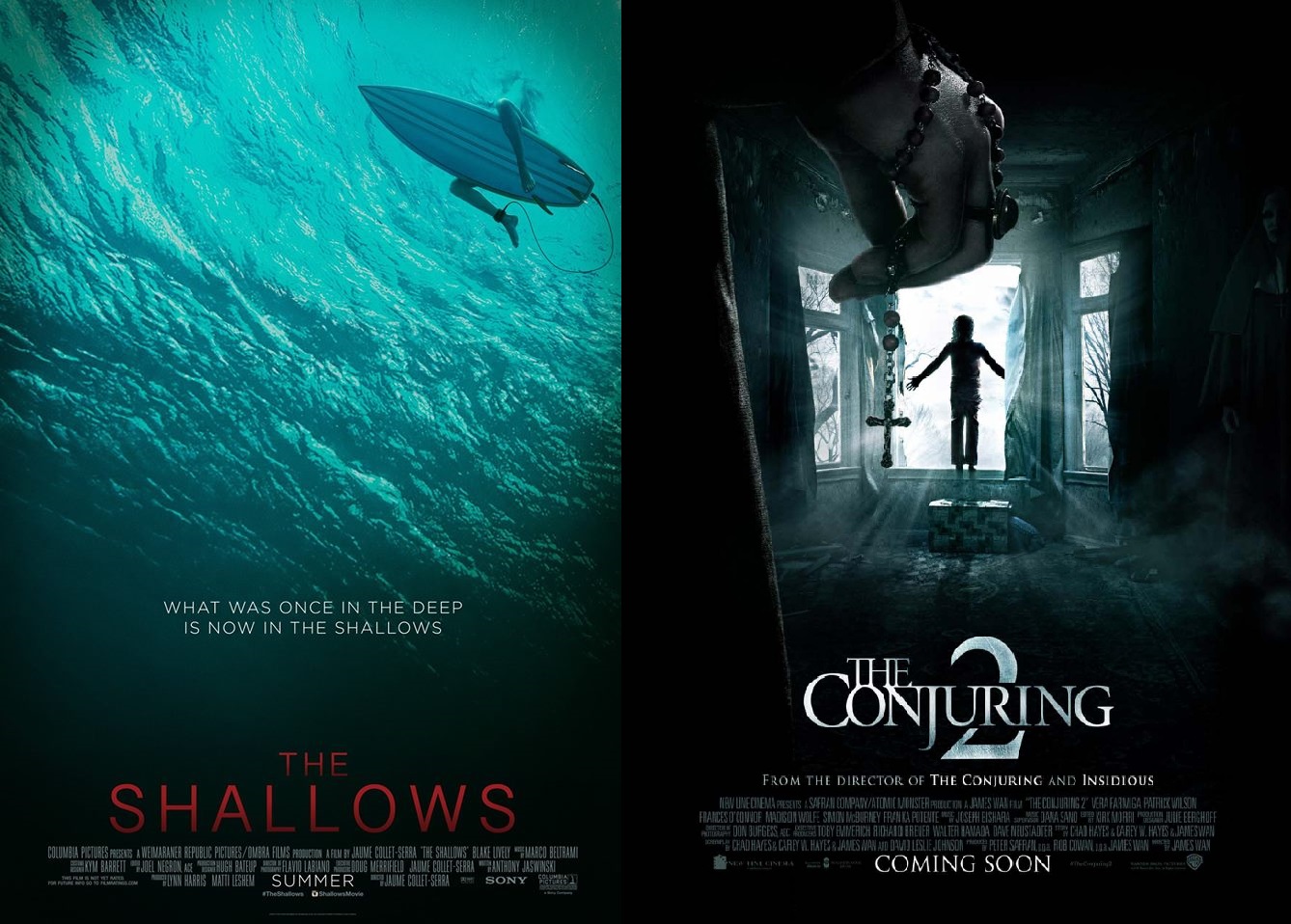
Film Review - THE SHALLOWS and THE CONJURING 2
We’re two months into the summer 2016 movie season and, so far, the narrative has been one of baffling failure, with costly blockbusters (aside from Marvel and Pixar franchises) repelling audiences one after another. But look beyond the gossipy disaster stories and there’s been another trend quietly unfolding, which is the encouraging success of skillfully directed, modestly budgeted horror counter-programming. Both Jaume Collet-Serra’s shark thriller The Shallows and James Wan’s spookhouse extravaganza The Conjuring 2 deliver in spades the type of clever empty calorie thrills and bracing excitement we’ve been conditioned to anticipate from their infinitely more expensive and hyped competition.
As a filmmaker, Collet-Serra isn’t exactly known for his grand auteurist ambition or innovative storytelling. However, previous efforts Orphan and Non-Stop have proven his worth as a peddler of colorful, imaginative and wildly entertaining trash that twists seemingly simple genre set-ups into something weirder and more unique. Consider The Shallows another feather in his slightly askew cap; an immersive single protagonist survival tale that is one of the few killer shark movies to land closer on the quality measuring stick to Jaws than, say, Shark Night 3D.
Headlined by a very game and committed Blake Lively, playing a grieving young surfer held captive a mere 200 feet from shore by an aggressively territorial great white, The Shallows is an impeccably assembled exercise in ever-ratcheting tension. The Barcelona-born director, operating with a mere 17-million-dollar budget, embraces his limitations by keeping his vicious CG co-lead obscured – a sleek, breaking fin here, a murky shadow there – much the way Spielberg so famously did back in the sunny days of 1975. And, similar to that enduring classic, or 2003’s effective Open Water, anxiety is generated by not quite knowing where the marine threat is from moment to moment. As we watch our heroine battle her way through various minor tasks, such as nasty self-surgery or travelling from a floating whale carcass to a sturdier rock, we’re always on edge, waiting for the leviathan to rise up.
Of course, this being a Collet-Serra joint, things invariably get pretty bonkers at a certain point. Although this characteristic descent into cartoonishness doesn’t quite work as well here – due to the stripped down, you-are-there nature of the film – as in past endeavors, his go-for-broke dedication to cheeseball overkill is bizarrely admirable. The man is nothing if not consistent. And if he keeps cranking out B-movie fare this fun, technically proficient and well-acted (even Lively’s avian co-star Steven Seagull turns in a stellar performance), his peculiar brand of high-concept craziness will always be welcome.
While The Shallows helmer has always played on the cheaper end of the studio genre flick system, James Wan – who exploded onto the scene in 2004 with cheapie shocker phenomenon Saw – hasn’t just flirted with the big time, he’s fast become a major player; pulling off Furious 7 with style, despite tragic complications, and signing on to captain DC’s Aquaman. But, watching the frequently terrifying, lovingly crafted sequel to his 2013 smash hit The Conjuring, you sure can tell where his warped heart truly remains. Any hack can create a cheap showcase jump scare for trailers to milk. He digs into this superior follow-up like a man possessed, infusing it with enough feverish, pulse-quickening suspense sequences to fuel over a dozen schlocky one weekend wonders.
Once again drawing inspiration from the true life (entirely bogus) experiences of paranormal investigators Ed and Lorraine Warren (portrayed on celluloid by Patrick Wilson and Vera Farmiga), The Conjuring 2 tremendously fictionalizes the famous events surrounding England’s late 1970s Enfield Poltergeist case. This scenario, which begins with simple bumps in the night tormenting a woman and her four children, before gradually evolving into possession and unthinkable supernatural chaos, affords Wan a wide variety of hellish scenarios to exploit to their profoundly chilling hilt. As mysterious hands push objects out of darkened tents, chairs travel uneasily across rooms and aged specters leer, scream and leave bite marks, you can practically sense the creator grinning sadistically between the frames.
What really makes this franchise work like gangbusters – as opposed to Wan’s two genuinely solid but unremarkable Insidious installments – is the grounding presence of Wilson and Farmiga. They’re so thoughtful, warm and compelling that their very human love story is as involving as the ghastly happenings surrounding them. And because we’re invested in them, and by extension the characters they’re fighting to protect (predominantly Frances O’Connor and talented young Madison Wolfe), the building dread and traumatic frights arrive loaded with an impact that’s surprisingly emotional as well as visceral. The Conjuring 2 again shows Wan to be a formidable master of the form, a ghoulishly ingenious talent rarely better than when he’s dragging unsuspecting ticket-buyers into the horrible recesses of his most hypnotic cinematic nightmares.
The Shallows: 3.5 out of 5
The Conjuring 2: 4 out of 5
Thursday, June 23, 2016
Film Review - FINDING DORY
Pixar has gotten a lot of flak over the last few years for their increased focus on sequelizing their most popular – and *cough* profitable – brands. And yet, with the huge, bold exception of 2011’s running-on-empty Cars 2, the rest have outdone or, at the very least, honored their delightful predecessors. Both Toy Story follow-ups were widely celebrated and embraced by fans, while the underrated Monsters University prequel brought enjoyable new energy, personalities and off-beat humor to the world created by Monsters, Inc.
Finding Dory, the dubious-on-paper extension of 2003’s Finding Nemo, once again proves the studio knows how to milk a property with creative zest, soulfulness and smarts, if a little less richly so than in the past. Returning writer-director Andrew Stanton (who also masterminded Wall-E) knows how to tell an involving tale and deliver the required emotional wallop, and here he ups the ante in terms of ambitious action set-piece staging. And although it’s pretty unlikely many will place this entry above its now classic Best Animated Feature Oscar-winning forebear, it does earn its place next to it on the shelf.
On a visual level, the film is arresting to behold. Vibrant and practically exploding with bright, striking colors Finding Dory captures the same sense of relaxing, tranquil beauty that comes from witnessing the most awe-inspiring of underwater sights. This movie is meant to be seen on the big screen, and it’s also the rare 3D experience that won’t leave you feeling ripped off when you’re tossing your plastic glasses into the recycle bin after the show. There’s an immersive quality to the animation Pixar’s team of artist wizards have accomplished that not only irresistibly draws you into the wondrous setting, but also helps keep your attention rapt during some of the more busy and ultra-cartoony later happenings.
Tugging at the heartstrings right from the get-go, the picture opens with an effective and adorable childhood flashback wherein the short term-memory challenged blue tang (Ellen DeGeneres as adult Dory, Sloane Murray as infant) is separated from her loving parents (Eugene Levy and Diane Keaton) after wandering off on her own. Unable to remember how to get home she embarks on a scattered and lengthy expedition, forced to depend on the kindness of strangers, all the while travelling farther and farther from her destination. This sad, fruitless journey ultimately draws her to the panicked Marlin (Albert Brooks), as he searches for his lost son.
Cut to one year later. Living happily with Marlin and Nemo (Hayden Rolence, replacing Alexander Gould), the plucky and carefree Dory experiences a sudden revelation about the location of her lost parents following a clumsy stingray accident. Dragging her two reluctant pals with her, she ventures to the California-based Marine Life Institute (which has a prominent celebrity spokeswoman!), where injured and sick fish are rehabilitated for release back into the ocean. There she finds an invaluable ally in surly seven-armed octopus “septopus,” Hank (Ed O’Neill, perfectly world-weary), who agrees to help in exchange for assistance in attaining a transfer to permanent aquarium captivity. As the two clownfish attempt to save Dory from herself, she and Hank embark on a chaotic and dangerous odyssey through the park in order to complete her lifelong quest.
However, Finding Dory’s emphasis on lightning-paced episodic escapades also makes the film feel a bit hurried. Kids will undoubtedly get a rush from its madcap drive, but older viewers may yearn at times for the comparatively more restrained storytelling techniques of superior Pixar efforts such as Up, The Incredibles or Ratatouille. Especially once the genuinely moving tear-jerking developments arrive and it feels like the movie’s nervous about allowing much breathing room for fear of losing momentum.
Because it’s hard, as an adult, to not desire more occasional pauses to appreciate and consider the picture’s compelling and powerful central theme; highlighting the countless challenges placed on those living with special needs. The best section of the film – which belongs in the pantheon of all-time great Pixar achievements – is an extended first-person sequence where a distressed Dory finds herself alone, confused and helpless, and must rely on her own unique coping strategies to talk herself through the situation. It’s scenes like this, as well as the poignant time spent with our heroine and her parents, that reminds us just how magical, essential and matchless the studio can be when they’re firing on all cylinders.
And, frankly, Pixar’s most fearsome competitor at this point – outside of the extremely odd Disney or Dreamworks miracle like Zootopia or How to Train Your Dragon - is themselves. Having created a procession of modern masterpieces they’ve set a bar that’s just not possible to clear every time out. So although Finding Dory only belongs somewhere in the middle of their priceless catalogue, it’s still a sweet, fun and engaging spectacle that enthusiastically swims along in very, very good company.
Finding Dory, the dubious-on-paper extension of 2003’s Finding Nemo, once again proves the studio knows how to milk a property with creative zest, soulfulness and smarts, if a little less richly so than in the past. Returning writer-director Andrew Stanton (who also masterminded Wall-E) knows how to tell an involving tale and deliver the required emotional wallop, and here he ups the ante in terms of ambitious action set-piece staging. And although it’s pretty unlikely many will place this entry above its now classic Best Animated Feature Oscar-winning forebear, it does earn its place next to it on the shelf.
On a visual level, the film is arresting to behold. Vibrant and practically exploding with bright, striking colors Finding Dory captures the same sense of relaxing, tranquil beauty that comes from witnessing the most awe-inspiring of underwater sights. This movie is meant to be seen on the big screen, and it’s also the rare 3D experience that won’t leave you feeling ripped off when you’re tossing your plastic glasses into the recycle bin after the show. There’s an immersive quality to the animation Pixar’s team of artist wizards have accomplished that not only irresistibly draws you into the wondrous setting, but also helps keep your attention rapt during some of the more busy and ultra-cartoony later happenings.
Tugging at the heartstrings right from the get-go, the picture opens with an effective and adorable childhood flashback wherein the short term-memory challenged blue tang (Ellen DeGeneres as adult Dory, Sloane Murray as infant) is separated from her loving parents (Eugene Levy and Diane Keaton) after wandering off on her own. Unable to remember how to get home she embarks on a scattered and lengthy expedition, forced to depend on the kindness of strangers, all the while travelling farther and farther from her destination. This sad, fruitless journey ultimately draws her to the panicked Marlin (Albert Brooks), as he searches for his lost son.
Cut to one year later. Living happily with Marlin and Nemo (Hayden Rolence, replacing Alexander Gould), the plucky and carefree Dory experiences a sudden revelation about the location of her lost parents following a clumsy stingray accident. Dragging her two reluctant pals with her, she ventures to the California-based Marine Life Institute (which has a prominent celebrity spokeswoman!), where injured and sick fish are rehabilitated for release back into the ocean. There she finds an invaluable ally in surly seven-armed
Intentionally mirroring their protagonist's brief attention span, Stanton and his co-writers have structured their film with an emphasis on sporadic incident over smooth narrative flow. This approach unquestionably allows for a wider variety of mini-adventures, as both Dory/Hank and Marlin/Nemo head off in different directions, with an abundance of fertile possibilities for comedy and go-for-broke imagination. In addition to Hank’s endless hilarious camouflage demonstrations, there’s also plenty of time for memorable encounters with new series additions such as short-sighted whale shark Destiny (Kaitlin Olson), a pair of hooligan sea lions (reunited The Wire co-stars Idris Elba and Dominic West) and a particularly dim loon named Becky. Also extraordinary is a visit to a fish petting pool that manages to be simultaneously nightmarish and totally side-splitting.
Because it’s hard, as an adult, to not desire more occasional pauses to appreciate and consider the picture’s compelling and powerful central theme; highlighting the countless challenges placed on those living with special needs. The best section of the film – which belongs in the pantheon of all-time great Pixar achievements – is an extended first-person sequence where a distressed Dory finds herself alone, confused and helpless, and must rely on her own unique coping strategies to talk herself through the situation. It’s scenes like this, as well as the poignant time spent with our heroine and her parents, that reminds us just how magical, essential and matchless the studio can be when they’re firing on all cylinders.
And, frankly, Pixar’s most fearsome competitor at this point – outside of the extremely odd Disney or Dreamworks miracle like Zootopia or How to Train Your Dragon - is themselves. Having created a procession of modern masterpieces they’ve set a bar that’s just not possible to clear every time out. So although Finding Dory only belongs somewhere in the middle of their priceless catalogue, it’s still a sweet, fun and engaging spectacle that enthusiastically swims along in very, very good company.
3.5 out of 5
Subscribe to:
Posts (Atom)