Labels

Monday, June 20, 2011

Film's 5 Most Nauseating Dinner Table Scenes

As anyone who’s ever spent much time with me can attest, I'm a pretty picky eater (I prefer the term "cautious consumer"). It seems to run in the family. Hence, there are few things more unbearable than revolting eating scenes in movies or television. Inspired by a recent viewing of one of the films mentioned on this list, I decided it was time to assemble my own personal Top 5 Most Nauseating Dinner Table Scenes in cinema. The criterion was easy: did the moment in question make me gag? All five of the titles listed below managed that task. Perhaps, a bit too well for my taste...

Before we begin, there were a few regrettable exclusions. I would have loved to include Monty Python's The Meaning of Life and Oldboy but, alas, they feature characters eating alone. I was looking for the communal experience. Misery loves company, after all. Julie Taymor's adaptation of Titus also came close, but I decided one Anthony Hopkins movie was enough. Plus, it frankly doesn't belong in the same category as the five that were ultimately chosen.

5) Indiana Jones and the Temple of Doom (1984) - Steven Spielberg and George Lucas must have been cackling like a pair of naughty school children while assembling their nightmarish Indian banquet from this second Indiana Jones adventure. After all, with a menu that includes such delicacies as chilled monkey brains, eyeball soup, beetle innards and "Snake Surprise," there must have been precious little doubt that audiences would squirm, wince and retch until scene's end. It wound up being one of Temple of Doom's most iconic moments, and ensured that we would never again have to wonder what it would look like to see a grown man scarf down a live eel whole. Ick.

4) Alien (1979) - Was it not punishment enough that Kane (John Hurt) had to spend a couple days confined to the infirmary with a giant space insect suckered to his face? Could he not just be left alone to enjoy a pleasant dinner of freeze-dried rations with his friends and co-workers? Apparently not, as director Ridley Scott soon subjects the poor sap to the worst case of indigestion known to man. When that toothy creature explodes out his chest, spraying the table with showers of gore and entrails, all semblance of calm is instantly eradicated, along with our appetites.

3) Hannibal (2001) - This Silence of Lamb sequel paid off its predecessor's unforgettable closing line "I'm having an old friend for dinner" tenfold. Although the movie itself is a pretty mixed bag, it's doubtful many will ever forget the sight of a dazed Ray Liotta, sans the top half of his skull, being fed sautéed chunks of his own sliced-off grey matter and savouring every stomach-turning, squishy chew. Thomas Harris' original novel had Julianne Moore's Clarice eagerly joining in on the brain-food feeding frenzy but, fortunately, director Ridley Scott (who, judging from #4 as well, apparently has a thing for gross-out meal gatherings) spares us that sight and instead provides us with a relatable dinner party member; one who makes no effort to shield her revulsion. Too bad she's not present at the film's end when an escaped Dr. Lecter (Anthony Hopkins), aboard a flight, offers his leftovers to an impressionable young seat-mate.

2) The Texas Chainsaw Massacre (1974) - A dinner party requires great company to succeed, so what happens when the company consists of a screaming family of inbred hillbilly cannibals? Such is the scenario faced by Sally Hardesty (Marilyn Burns) in director Tobe Hooper's horror masterpiece. Awakening at a dilapidated table, shackled to a chair made from human remains, the hysterical heroine shudders and screeches in terror as the villainous family of man-eating mass-murderers hoot, howl and paw perversely at her blood-stained hair. As if that wasn't bad enough, set right in front of her is a plate of unpleasant meat products of questionable origin. Why, it's enough to send a poor soul shrieking like a banshee into the night! Not surprisingly, Sally soon does just that, without thanking her hosts on the way out. Unsurprisingly, this situation was repeated in future sequels/remakes/prequels - probably most gruesomely in 1986's The Texas Chainsaw Massacre 2 - but none were as potent as the originator.

1) Eraserhead (1977) - There are few greater discomforts than having to eat dinner at a prospective romantic partner's parents' house. The potential for awkwardness alone is enough to make anyone break into a sweat. David Lynch, who's rarely stooped to subtlety in exercising his gift for mutating the mundane into the sickening, uses his audacious debut to create the mother of all disturbing family dinners. In Eraserhead, Henry Spencer (Jack Nance) is urged, by his girlfriend's seemingly lobotomized plumber father (Allen Joseph), to carve a pathetic genetically modified chicken. Just as he's about break the skin, the tiny morsel's legs start to kick, and slick black, bubbling blood begins to ooze out all over the spotless white plate. Then mom (Jeanne Bates) starts spasming like Linda Blair. It's a repulsive sequence which is, troublingly, merely just a hors d'oeuvre for the plethora of cringe-inducing horrors still to come.

Saturday, June 18, 2011

Film Review - GREEN LANTERN

For a fledgling franchise, Green Lantern sure does spend an inordinate amount of time trying to make the extraordinary feel tediously ordinary. When you have a multiple galaxy-spanning storyline, and cast featuring hundreds of bizarre-looking alien marines, why settle for giving audiences lazy earthbound action beats involving helicopter accidents and hordes of extras running in terror through city streets from a big, boring CG monster? In a superhero epic where the hero can traverse the solar system in the blink of an eye, or conjure bizarre weapons out of pure energy, who wants to watch him mope around his apartment in self-doubt or try to win back his boring ex? We've seen these things done too many times already, and done with far more wit and enthusiasm.

Sure, on the surface, DC Comics’ emerald-hued icon's mythology comes across as being a mite silly in live-action, but there's no reason a grand space opera couldn't have been adapted from it. Audiences are willing to step into the fantastic if there's an exciting tale to be told that they can emotionally invest themselves in. Imagine if James Cameron's Avatar had only spent 15 minutes on Pandora, and the rest in the military base. Or if Luke Skywalker had ran back to the moisture farm shortly after stepping through Mos Eisley's dingy doors. That's Green Lantern in a nutshell; a dull wannabe sci-fi epic with zero confidence in its own appealingly unique creative strengths.

Even worse, I'm not exactly sure who this film was made for. It's often too campy and cartoonish - at one point the hero creates a giant Hot Wheels track to save a crashing vehicle - for adults to take very seriously, but also too lethargic and violent to engage young children. Many fans of the comic books will likely take issue with the one-note renderings of their favourite characters, and lack of dynamic space battles, while newcomers to the brand may be put off by the movie's convoluted, sloppily sketched-out mythology and thoroughly unimaginative origin tale structure.

The film follows the adventures of Hal Jordan (Ryan Reynolds), a cocky test pilot in the Maverick mould, who, late one night, is up and whisked away to a fallen space-craft containing a mortally injured extra-terrestrial named Abin Sur (Temuera Morrison). A victim of the life-draining, fear-powered intergalactic entity Parallax, Sur presents the irresponsible human with a magic ring and lantern, which harness the green energy source of will, and inducts him into the Lantern Corps, a team made up of hundreds of intergalactic peacekeepers who patrol the many sectors of the cosmos. Upon inadvertently activating the clunky piece of jewellery in a parking lot brawl, Jordan is zapped to the realm of Oa, where he's given instruction on his uncanny powers - which allow him to make his imagination spring to life via energy-based "constructs" - by the warriors Kilowog (Michael Clarke Duncan), Tomar-Re (Geoffrey Rush) and, most importantly, Sinestro (Mark Strong), the valiant ringleader of the Lantern squad.

Meanwhile, back on Earth, the body of Sur has been discovered by the U.S. government and handed over to painfully nerdy xenobiologist Hector Hammond (Peter Sarsgaard). During the autopsy procedure, a fragment of Parallax leaks out of the alien's corpse and infects the insecure scientist, causing grotesque physical mutation and infusing him with potent telepathic and telekinetic abilities. As Hector begins to go insane, Hal Jordan struggles to accept his newfound responsibilities and regain the love of Carol Ferris (Blake Lively), a fellow pilot who has long since grown weary of her colleague's reckless attitude. Following an unsuccessful attempt by Sinestro and the Lanterns to capture Parallax, the menacing entity heads towards Earth and it’s up to Hal to step up and save the world.

Green Lantern's script, cobbled together by a committee of four writers, accomplishes the paradoxical feat of being both rushed and ponderous. At 105 minutes, the film repeatedly spins its wheels by showing us dreary scenes of Hal sulking or staring at the horizon (this passes for character development), and listening to platitudes from Lively's Carol, yet skips over several fundamental building blocks of good storytelling. We’re supposed to feel something for Hector Hammond, but he isn't introduced until it's time for his transformation. Then, the movie attempts to establish a strong connection between him, Hal and Carol in a couple throwaway lines of dialogue. How are we supposed to care about a relationship that's central to the film when there's little on-screen evidence that it even exists?

Much of the picture works that way. We don't see things happen, so much as hear other people talk about them. The Lantern Corps, allegedly, are a near unstoppable intergalactic police force, yet they spend their sadly limited screen-time losing fights and standing around on Oa shining their rings in the air. Everyone endlessly informs Hal what a screw-up he is, but we rarely see him behave in a selfish manner outside of an effective early jet fighter training sequence. In Iron Man, Tony Stark's flaws were laid bare for us to see, and we loved him for them and were eager to watch his metamorphosis. Perhaps Green Lantern's writers were wary of making Hal too unlikable but, by making him so wishy-washy, he's impossible to root for. The film asks us to believe that only Hal is up to the task of tackling Parallax, yet we only see him train with the Corps for five (entertaining) minutes before quitting the group, and having a couple close-call scuffles with Hector. We're expected to accept that growth has occurred without seeing any of it actually transpire.

I'd be curious to know how much material wound up on the cutting room floor. There are a number of jarring edits in the film that make nary a lick of sense. Hal's first confrontation with Hector feels like an island unto itself, with no lead in or denouement. It just happens and then we return to business as usual. As well, Hal's trips between Oa and Earth in the latter half of the movie seem to occur almost at random.

It's unclear why director Martin Campbell was selected to helm this particular project. He's proven adept at kick-starting more grounded heroes like James Bond (Casino Royale, GoldenEye) and Zorro (The Mask of Zorro), but is hardly the go-to guy when you need to sell the otherworldly. Although he never embarrasses himself, there's no spark of invention in his grand CG superhero action sequences. Lantern's powers, which could be really fun in an inspired Looney Tunes-kinda way, are just delivered matter-of-factly. They don't look terrible, but they also aren't particularly thrilling or dazzling. They're just effects for the sake of being effects. The same could be said for the climactic battle with Parallax, though I’m tempted to give Campbell a pass on that one, as I remain unsold whether any director is capable of making a scene depicting a human-being in combat against an evil space cloud cool. Fantastic Four: Rise of the Silver Surfer couldn't pull it off, and neither can Green Lantern.

The cast does what it can with lame material and, for the most part, flounders. As Hal, Reynolds is pleasant enough, and obviously has the masked avenger physique down, but spends too much time looking sheepish to be compelling. He's as edgy as rice pudding, and even his patented ironic observational one-liners feel forced. Lively, competently playing Generic Love Interest, has a few amusing bits, such as during her first face-to-face with Lantern, but is saddled with dialogue no actress should have to utter with a straight face, while Mark Strong acquits himself admirably with what is essentially a non-character (Sinestro, a major staple of the comics, is anything but here). Only Sarsgaard leaves an impression, with a creepy, broad villainous performance that could have been a milestone had Hector Hammond not wound up being completely inconsequential.

Everything about the picture feels weighed down by a crushing sense of nervous obligation; to both expanding DC’s cinematic presence and cramming in enough fan-service moments to appease the faithful. However, by following the strict template established by its forebears so joylessly, and short-changing its own potential in fear of offending the average movie-goer, it fails to inspire anything other than apathy. Green Lantern may shine brightly in the comic-book world, but his value in the universe of on-screen superheroes couldn’t be any less murky.

2 out of 5

Friday, June 10, 2011

Film Review - SUPER 8

Ordinarily, it's not really fair to criticize a new release for failing to live up to a milestone of the art-form. Classics come with too much baggage, and have had the benefit of time to saturate the public consciousness and become something larger and more important than a mere motion picture. So, what then to make of J.J. Abrams' Super 8, a reasonably efficient thrill-ride nostalgia trip that so desperately wants to stand on the shoulders of giants and invite warm comparisons to watershed Spielberg masterpieces such as Close Encounters of the Third Kind and E.T.? How can one clearheadedly judge a film that so blatantly muddies the waters by mining its most effective elements from treasured memories of the past?

I'm not sure it's possible. For some, Super 8 will be held in high regard purely for its uncanny ability to tap into the nostalgic mindset of its audience. This is a film that seems determined to make ticket-buyers wistfully yearn for childhoods they never actually had. That's not necessarily a fault of the picture, so much as a statement of its obvious intent. I heartily enjoyed the majority of my time spent in the film's idyllic 1979 setting, surrounded by its Goonies-like gaggle of precocious film buffs, but, leaving the theatre, I couldn't help but feel a little let down that the film didn't swing for the fences. When Spielberg blazed new ground with material like this, he infused it with passion, intelligence and tingle-inducing wonder. He created films you didn't just watch, you experienced. Abrams, on the other hand, doesn't have the same drive for innovation or grandeur, and never quite manages to fully immerse us in his world. It's a fun entertainment, but not a whole lot more.

Set in the sleepy Ohio suburbs, Super 8 stars impressive newcomer Joel Courtney as Joe Lamb, a sensitive 12-year-old recovering from the loss of his mother, who died in a tragic mill accident. Obsessed with monsters, movie make-up and homemade model kits, he's in the midst of shooting a super 8 zombie movie with his friends and rebellious crush Alice Dainard (Elle Fanning - a dead ringer for a pre-teen Drew Barrymore) late at night, when a cargo train mysteriously, not to mention explosively, derails. Soon, the military - who enter the picture as ominous flashlights in the night ala E.T. - are swarming the area looking for... something. As the kids continue to assemble their project, strange occurrences begin to happen around town; dogs start running away. Electricity flickers on and off. Something is out there and its just a matter of time before Joe and his friends run headlong into it.

Naturally, if there's one thing almost every Spielberg work has in common, it's aloof father figures. Super 8 completes the homage package by supplying not just one of these all-important characters, but two! Joe's stern, grieving deputy sheriff father (the always welcome Kyle Chandler) urges his son to grow up and consider new hobbies, while Alice's deadbeat alcoholic dad (Ron Eldard) carries a shameful secret of his own; one which threatens to disrupt the slowly emerging romance between the two tweens.

Boldly confident from the get-go, Super 8 works best during its first hour, as we get to know and understand the kids and their little isolated universe. Abrams' script makes a wise call early on in delaying the kids inevitable involvement with the supernatural elements of the story until the third act. Sure, they're present for the fiery train-wreck - which is grand in scale but not as convincingly rendered as I suspect the filmmaker thinks it is, given how long he milks it on-screen - but soon their attention turns back to that which is most important to them; namely, their movie. Many screenwriters have failed miserably writing kids, but Abrams understands the innocent self-absorption that comes with that age, and implicitly realizes that, for them, making a movie isn't just a pleasurable activity, it's everything.

As he proved in his previous filmic forays, Star Trek and Mission: Impossible III, and high profile television work, Abrams posesses one of the canniest eyes for casting in the business. To his great credit, there is not a single child actor in the film who rings false. Courtney and Fanning ably share most of the spotlight, and generate the picture's most powerful dramatic fireworks, but the supporting cast is no less colourful. Riley Griffiths, as the crew's wannabe director, possesses just the right amount of gusto and bossiness, while Gabriel Basso, as the over-anxious leading man, earns the film's biggest laugh during an action sequence involving a bus. Ryan Lee, who boasts some truly daunting dental wear, is also delightfully true-to-life, playing that kid we all knew who never went anywhere without a lighter. These characters are an utter joy to spend time with and, unlike in Richard Donner's often tiresome The Goonies, their non-stop, overlapping chatter is funny, honest and comprehensible.

I really wish the film didn't trip so badly over itself once it introduces its otherworldly co-star. Had it played a less prominent role in the emotional pay-off of the film, it would be far less problematic than it is. Plainly put, Super 8's creature is a dud. Over-designed, poorly explained and always obscured by darkness (likely to hide the fact the CG is less than stellar), it's a generic non-entity in a film that requires us to care about it to truly triumph. Remember E.T.? He was both a brilliantly nuanced character, as well as a poignant metaphor for Elliot's impending loss of childhood. This movie's mysterious being has neither a personality nor clear thematic purpose. Worse, it's appearance in the third act disrupts the natural flow of the other story threads, leading to a rushed finale that badly undercuts the movie's grand attempt at a tear-jerking final moment of awe. Spielberg knew when to pace himself and let the audience bask in his fantastic images and sounds, whereas Abrams seems over-eager to wrap everything up as fast as possible and fade to black.

Yet, despite not succeeding at meeting the standards set by its influences, there's still plenty to recommend Abrams' quirky little film beyond the performances. There's so much love in each and every frame - from the kids' elaborately designed rooms, full of geeky little touches and period detail, to the quiet minutiae of small town life and, my personal favourite, the beautifully evocative shots of the spellbinding night sky - that it’s impossible to resist falling prey to the picture’s gentle whimsy. As a cinematic journey, Super 8 may fall short of the stars, but it's nonetheless a journey still worth taking.

3.5 out of 5

P.S.: Make sure to stick around during the credits to see the kids' completed super 8 movie. It just may be the most charming sequence in the entire film.

Cinematic Consumption - MEGA SHARK VERSUS CROCOSAURUS

Going in, Mega Shark Versus Crocosaurus had to accomplish very little to entertain me. I'm a total sucker for bad killer sea creature movies (Read my obsessive retrospectives for both Jaws 3-D and Jaws The Revenge for proof), and all I ask is that the filmmakers manage to throw in some weirdo inspiration here and there amidst the brain-jellying exposition and scenes of washed up actors staring at unconvincing computer monitor screens. A memorably gory kill, perhaps. Or a climactic monster death so astoundingly ridiculous you find yourself fumbling for the rewind button. Heck, even a winking bit of pointless nudity (an old genre standby that has sadly become a rarity).  I'm an easy customer.

Unfortunately, MSvsCS - as I shall henceforth be referring to it - fails to deliver any of these base desires. Oh, it's rated R, all right. For language. Language! This is a killer shark/crocodile movie whose most extreme element is the F-word! I really don't understand the logic behind that decision. Why make such a film and not deliver on the audience's modest expectations? It's not like there was ever a danger of anyone being invested in the storyline!

What is the storyline, you ask? Well, it's about a Navy acoustics scientist (Jaleel White - he who once wore suspenders, giant red-rimmed glasses and nasally uttered the immortal phrase "Did I do that?!" ever Friday night on ABC) who is developing a new audio technology to repel sharks.  After his fiancé is killed by Mega Shark, who sinks her battleship by leaping over it three times and smacking it with his tail, he is recruited by the military and a tanktop-wearing government agent babe (Sarah Lieving) to destroy the errant fish. But wait! Over in South Africa, a ginoromous prehistoric crocodile has emerged and escaped into the sea, causing the rough-around-the-collar resident croc-hunter (Gary Stretch - who looks like a squintier, sleazier, hairier Pierce Brosnan) to also be brought in on the action. Will the hunter and Urkel be able to put their differences aside and stop the carnivorous man-eaters once and for all? (Spoiler: Yes. Yes, they will.)   

It's amazing how sizable a chunk of this film is spent with Urkel, croc-dude and Agent Hotty McHotterson sitting in a fake helicopter cockpit tediously arguing over whether or not the scientist's "hydrosonic spheres" will save the day. (Spoiler: they do!) Even though the flick runs only 88 mins, I feel like I'm still trapped in that godforsaken airborne purgatory waiting for someone to take charge and DO SOMETHING! ANYTHING!!! No one sane expects strong writing in a direct-to-DVD creature feature, but if you're going to give actors awful dialogue, at least make it so wretched it's hilarious, not boring.

Further, this is a picture which, in its very title, promises an epic clash between the titular monsters. The reality, however, is much more disappointing. The two beasts, which look like refugees from a Super Nintendo game, chomp down on each other's tails in unison and form a rudimentary circle. They then spin around and around, repeatedly and bloodlessly. To add insult to injury, even when destroyed they remain locked in their eternal game of Ring Around the Rosie. This could be forgiven if there were a few decent human fatalities, but there aren't. Most are just swallowed whole, disappearing into a blur of ugly CG. Yawn.

Ultimately, MSvsCS is a complete waste of time. It lacks the so-terrible-it's-funny qualities that made Shark Attack 3: Megalodon and Raging Sharks quasi-brilliant, and never lives up to its deliciously pulpy title. Too bad, so sad.

I'll probably still watch the inevitable sequel...

1 out of 5

P.S.: It's never a good idea to name your submarine USNS Invincible. Soon or later, it will be proven to not be.

Wednesday, June 08, 2011

One-Sheet Showcase - STAR TREK IV: THE VOYAGE HOME (1986)


Category: Camp

I chose this poster to launch the inaugeral One-Sheet Showcase for a couple reasons, first and foremost being that I'm attending a Star Trek convention this weekend. What better way to celebrate my impending 3-day festival of fanboyism (and fangirlism) than with the goofiest official film poster ever inspired by the beloved space-hoppin' franchise?

Would I consider this a cool poster? No, not really. While The Voyage Home is easily the most light-hearted of the original cast's cinematic run, this one-sheet strictly sells the high-concept, fish-out-of-water comedy stuff (which, to be fair, it has no shortage of), rather than the crowd-pleasing sci-fi adventure tale elements involving a pair of humpback whales named George and Gracie. It's also hard not to childishly giggle over the fact that Spock and Kirk are beaming into San Francisco via rainbow. I imagine numerous slashfic authors hold this art up as one of their most profound inspirations.

All kidding aside, though, I still have a great deal of affection for this poster. Why, you ask? Because it unabashedly promises a carefree, fun time at the movies. Take a second and try to remember some recent blockbuster lobby art, not aimed at children, which actually tried to sell the movie as being a cheerful experience. It's harder than you'd think. Nowadays, everything has to look dark, intense and - the buzz word which is driving me slowly insane - "EPIC!"  Why is every franchise, no matter how good-natured and breezy (Pirates of the Caribbean or Iron Man, for example), sold on soberingly solemn images better suited to a wrenching period drama? Lighten up, people!

Certainly this Star Trek IV poster has no shortage of detractors in the fan community, but I like it because it's eye-catching, colourful and unpretentious - not to mention completely devoid of irony. It genuinely makes me want to see the film being advertised. Besides, it must have worked a little bit, as Voyage Home was the highest-grossing Trek film until J.J. Abrams' awesome reboot - which also had inappropriately moody one-sheets - dropped in 2009.

So while few die-hards would ever choose to own it over a vintage Wrath of Khan or Search for Spock print, I'm still greatful it made it out of Paramount's promotional department 25 years ago.

Cinematic Consumption - DEATH WISH 3

Death Wish 3 is not a good movie. In fact, it is - perhaps unsurprisingly - a pretty terrible one. However, unlike the vile second franchise entry, this flick figures out its tone from the very beginning and rides it out to the bitter, hilarious end. No one comes out of the film smelling rosy, but I'll be damned if I didn't laugh my fool head off throughout.

The fun continues as eternally cursed architect Paul Kersey (Charles Bronson) returns to his former hometown of New York. Now, you'll be forgiven for thinking the city looks a little odd, as the picture was shot in London. Which looks nothing like New York. At all. Rather, the entire film almost seems to unfold at the same bombed-out location where the finale of Saving Private Ryan took place; all mountains of debris, crumbling brick buildings and poorly-maintained, empty streets. Populating the town is roughly thirty sadistic gangland punks and about a dozen mournful citizens (the latter of which trudge, shoulders slumped and heads down, solemnly along the sidewalks waiting to have their grocery bags knocked out of their hands or purses stolen - an occurence which takes place every 5 mins or so in the movie.) I hate to blame the victim, but when you're outnumbered by bloodthirsty psychopaths who attack you on a daily basis, it's probably high-time to wise up and peruse the real estate ads.

Anyhow, Kersey shows up at an old friend's house, only to find him savagely beaten. After his final side-splittingly operatic death rattle, the cops bust in and arrest the baffled former vigilante. But all is not as it seems. Dimwitted police chief Shriker (Ed Lauter) - whose office looks like it was constructed in an elementary school classroom - decides that the old gun-wielding lunatic is the lesser of two evils and sets him loose, with a plea that he keep the cops informed of his activities. Which he promptly doesn't. Soon, the gang starts picking off saintly locals and Kersey is pressed back into action. By the end, the entire "city" is at war, as smiling old folks and shopkeepers, following the senior citizen ass-kicker's noble example, take up arms and blow every single facepaint-wearing hoodlum to hell. It's the ultimate NRA wetdream.

Yesterday, I made no attempt to hide my disgust for Death Wish II (Notice how the roman numerals disappeared with this chapter? Too bad. I really prefer uniformity in my movie titles), yet I had an ironic blast with this installment. Returning director Michael Winner has made an amusingly  moronic campfest, full of ludicrous ultraviolence, phony sets and plenty 'o  kroovy, that never for one moment convinces the viewer that it's transpiring in anything resembling the real world. This is Bronsonland, dammit, and it's a deliriously silly place to be, where everyone dies oh-so-spectacularly and youths dress like Billy Idol's reject back-up band. Even the horrific violence against the elderly is forgiveable as - on-screen - it's committed solely on overweight stunt men in embarrassing wigs. In fact, the only depressing element of Death Wish 3 is having to watch Martin Balsam, the great character actor who appeared in Psycho, Cape Fear and 12 Angry Men, cash a paycheck.

Actually, come to think of it, the love story between Kersey and a ditzy public defender (played badly by Deborah Raffin, who was 32 years younger than Bronson. Ick.) was pretty freakin' grim to endure too.

The Death Wish franchise is beginning to remind me of a far less awesome version of the Rambo series. The first is an effective character piece, while the follow-ups devolve into carnage-strewn blast-o-ramas. Does this mean that Death Wish 4: The Crackdown or Death Wish V: The Face of Death (Obviously, I can't stop now!) will manage, like 2008's Rambo, to unite the opposing strengths of the first and later films and create a satisfying whole?  Honestly, I ain't holding my breath.

1.5 out of 5

Tuesday, June 07, 2011

Cinematic Consumption - DEATH WISH II

What an utterly revolting pile of rotten celluloid this is! Whereas 1974's Death Wish, while hardly a great movie, was at least an intriguing, straight-faced character study of a peaceful man driven mad by urban decay and a gruesome attack on his family, this sequel wallows into the muck and asks us to celebrate it's irredeemable qualities. I'm no prude when it comes to shocking or disturbing subject matter, but this flick left me desiring a hot shower.

Taking place 2 years after the first film, Charles Bronson's Paul Kersey has put his vigilante ways behind him - a character change that makes little sense given the original's ending - and is once again living a peaceful life as an architect, lovingly supported by his radio reporter girlfriend Geri (Bronson's former flame Jill Ireland). One day, while out at a fair with Geri and his mentally traumatized daughter, who still hasn't recovered from her sexual assault in the first film, he's accosted by a group of colourfully garbed punks (including a very young Laurence Fishburne in stupid pink sunglasses) who steal his wallet. Kersey chases them off but, in an act of revenge, the nogoodniks break into his house and savagely gang rape and murder his latina housekeeper. Then, when Kersey returns home, they knock him out and kidnap his daughter and rape her too. After she's killed - courtesy of being impaled on sharp fence posts (Seriously!) - Kersey moves into a hovel, dresses as a homeless man, and sets out to even the score.

On a B-movie level, Death Wish II could have worked. Sure, it's trashy stuff, but there's no reason that it couldn't have been fun in a cheesy exploitation movie kinda way. However, returning director Michael Winner seems unsure of how to move away from the grim seriousness of his first instalment. He tries for over-the-top cartoonishness in his treatment of the teen thugs - who are about as threatening as the gangs in West Side Story - and Bronson-delivered violence, but uncomfortably revels in the unnecessarily prolonged scenes depicting horrific violence against women. No breasts are left unbared, and all dignity is out the window as Winner lingers sadistically on ever scream, plea for mercy and choking sob from his on-screen victims. Even worse, the rape of Kersey's handicapped daughter is bizarrely shot so as to be erotic, which is, frankly, intolerable. By the time the third such scene rolled around, I loathed Winner and his dubious filmmaking morals far more than the utterly laughable criminals.

Then, after thirty or so minutes of this torture, we're supposed to cheer as Kersey ploddingly wanders around town gunning down the guilty. But, personally, I was so disgusted with the film, that I just watched, bored and numb, waiting for the 88 minute runtime to reach its welcome end. Even Bronson seems embarrassed to be associated with the project, and does little more than smirk, squint, stalk and shoot. Death Wish II isn't just a bad film; it's a loathsome and stupid one.

1 out of 5

Monday, June 06, 2011

New Content Coming Soon

I think it's been pretty obvious since the beginning that this blog is a constant work-in-progress. Sure, it's always been a home for reviews, and the always incredible Epi-Cast podcast, but other features have had far less staying power. Remember the Epitorials and video reviews? Boy, those sure didn't last long... 

Well, in an effort to help provide content outside of the standard full-length reviews, I'm going to add a pair of new features that will help add to the site's value.

The first new addition will be Cinematic Consumption. This new feature will be a personal viewing diary of sorts, with short reviews/reflections on movies I've just watched. This will hopefully allow more space for the older films I view. Why should new releases have all the fun? Huh? Tell me!!! The entries will be less structured and dense than the standard reviews, and, hopefully, more candid and tongue-in-cheek. When appropriate, of course.  

The second will be a weekly feature called One-Sheet Showcase, in which I'll post some of my favourite movie posters. Those chosen will run the gamut from awesome to hilariously campy, with commentary as to why I chose them. Look for those to be posted on Wednesdays.

So, there you have it. Lots to be excited about if you're easily excited! See you soon!

Wednesday, June 01, 2011

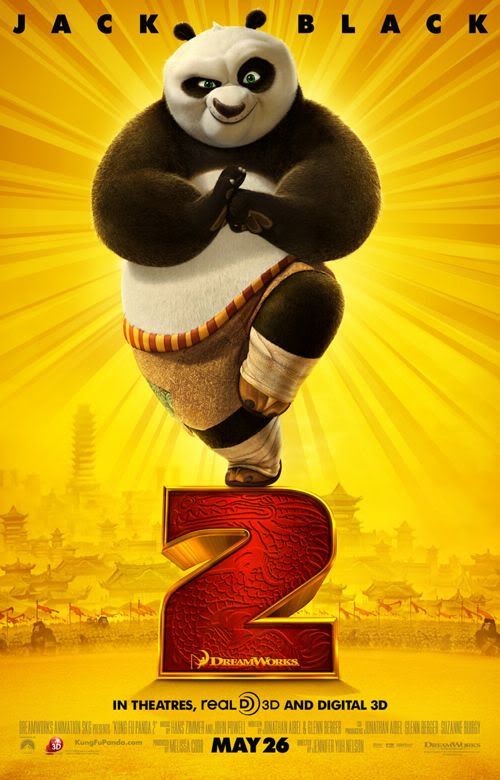
Film Review - KUNG FU PANDA 2

As an animation studio, DreamWorks hasn’t exactly established a reputation for high quality product. Oh, they churn out hits, by gum, but precious few come within spitting distance of Pixar’s oft-miraculous output. Occasionally they manage to work wonders – How to Train Your Dragon being the most recent glowing example – but more often than not they fall back on their time-tested, nutrient-free, wash, rinse and repeat formula of simplistic storytelling, A-list celebrity voice-casting and half-assed pop-culture references. The results are usually harmless, fluffy and entirely forgettable. Over the Hedge, anyone?

2008’s Kung Fu Panda should have fallen into that category. Conceptually, it came across like a hellish cinematic launch pad for a merchandizing bonanza. What kid wouldn’t want a cute stuffed animal that could do martial arts? Especially one voiced by wacky Jack Black and featured in TV spots scored to Tom Jones’ long-past-played-out ditty “Everybody Was Kung Fu Fighting?”

Yet, the film was surprisingly endearing; a charming and respectful candy-coloured love letter to classic Hong Kong cinema that actually contained a number of genuinely dynamic action sequences. It also had true heart, along with a solid laugh ratio, and played as strongly to kids as it did adults. Kung Fu Panda became a big box-office smash for the studio and, despite losing the Best Animated Oscar to Pixar’s Wall-E, nonetheless managed to earn a spot on several year-end Best Of lists. Thus, a sequel was inevitable.

Now, just three short years later, we have Kung Fu Panda 2, which shares its predecessor’s cheerfully kinetic visual sense and reverence for all things chop socky, but lacks its narrative oomph. Our hero, Po (Black), is still a lovable goofball with an unconquerable appetite, albeit one who has mastered martial arts and earned his rightful place fighting alongside the Furious Five – which includes legendary warriors Tigress (Angelina Jolie), Monkey (Jackie Chan), Viper (Lucy Liu), Crane (David Cross) and Mantis (Seth Rogen). All is well and good until villainous peacock Shen (Gary Oldman) happens onto the scene. Disgraced after being exiled from his homeland many years ago for a vicious campaign of panda-cide, Shen intends to conquer all of China by unleashing his new catastrophic weapons which utilize... gunpowder!

As if a canon-wielding, metal-taloned peacock with terrible dreams of domination and an army of ravenous wolves wasn’t enough to contend with, Po must also grapple with the newfound discovery that his adoring goose dad Mr. Ping (James Hong) may not actually be his biological father(!). Unfortunate for our hero, the only individual capable of divulging his mysterious parentage is Shen, who is none-too-forthcoming with answers. In order to triumph, Po must overcome his emotional baggage and achieve inner-peace – an elusive state of being that only true kung fu masters are capable of attaining.

Directed by series newcomer Jennifer Yuh, and written by returning scribes Jonathan Aibel and Glenn Berger, Kung Fu Panda 2 wastes no time in catching viewers up to speed. Shen’s threat is established immediately – courtesy of a beautifully animated prologue which depicts his violent backstory with traditional Chinese paper dolls – and Po and the Furious Five are off and running shortly after being reintroduced. However, unlike the first film, which had a sturdy narrative structure, this second entry feels repetitious and slightly aimless. We can only watch our heroes track down the villain and engage in hand-to-hand combat so many times before we start to check our watches. Further, the connection between Po and Shen doesn’t feel as powerful and spot-on as it should. Sure, it leads to a gorgeous anime revelation in the spirit of classic heartstring-tugging Disney, but even that moment feels more like plot housekeeping than an organic story development.

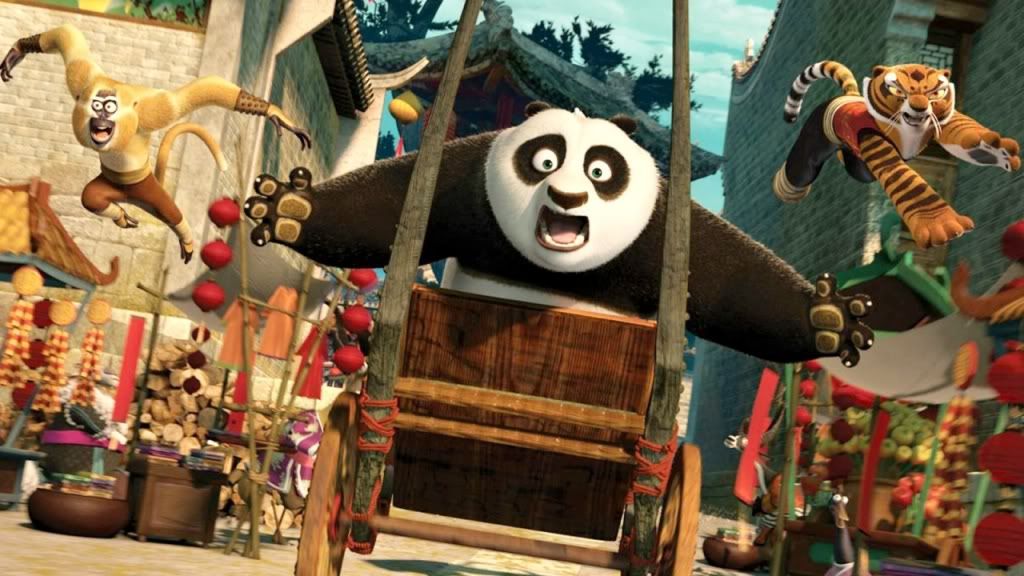
While the script often lets the picture down, there are still plenty of dazzling visuals to maintain a hold on the viewer’s attention. There’s an imaginatively chaotic rickshaw chase through the streets and a valiant ascent up a rapidly collapsing tower that are both brilliantly choreographed and staged, and a climactic battle involving a fleet of glowing, red lantern-lit ships that’s a feast for the eyes. Although the background extras often look like cut-and-paste copies of one another (a common DreamWorks deficiency), the film’s fantastical representation of mythic ancient China is distinctive and well worth savouring on the big screen. That said, my favourite bravura bit comes early on, when Po and the Furious Five dive off a cliff into action and the camera follows them as they plummet down, down, down, until we almost feel our stomach rise up.

Once again, Jack Black is front and centre and more than comfortable riffing when called upon to do so. The actor, who can be tiresome when let loose in the live action realm, is well-suited to animation. His outsized persona is already near that of a cartoon’s. It’s long been a weakness of the franchise that he isn't given many strong personalities to bounce off. Despite an all-star supporting cast, most of the other actors seem to have recorded their brief dialogue snippets over a short lunch break. Jolie’s Tigress has a little more to do this time, but most of her on-screen duties require her to act as the painfully sober voice of reason. Hoffman’s presence is lessened considerably this time around – down to really only one juicy early scene – while Rogen’s role consists of telling a pretty lame joke. Twice. As before, Chan, Cross and Liu are pretty much wasted, as is Jean-Claude Van Damme, playing imprisoned palace guard Master Croc. Only Oldman’s silky menace and James Hong’s hyperventilating daffy dad (the series’ greatest secret weapon, as far as I’m concerned) manage to leave a lasting impression.

When all is said and done, and the last baddie has been skadooshed, Kung Fu Panda 2 is an amiable enough family film that will doubtlessly enthral those in the single digits. The picture is vibrant and peppy, and perfectly content to tell a safe, inoffensive story that doesn’t travel down any daring new roads. It’s a decent enough first sequel, but if the adventure is to continue – and the cliffhanger ending implies it soon will – DreamWorks needs to seriously consider boosting this Panda’s mojo.

3 out of 5

Monday, May 23, 2011

Film Review - PIRATES OF THE CARIBBEAN: ON STRANGER TIDES

When Gore Verbinski’s Pirates of the Caribbean: The Curse of the Black Pearl exploded like a stray cannonball onto the scene in 2003 it felt like a blast of fresh air. Irreverent, smart and thrilling, and fronted by an instantly iconic Johnny Depp as the mincing, deceptively imbalanced Captain Jack Sparrow, it was one of the best summer blockbusters of the decade and quickly amassed a legion of fans. Unfortunately, the series' creators seemed perplexed by the sly swashbuckling appeal of the film, and produced two gargantuan-sized sequels of varying quality which stretched the property's thin mythology to the breaking point and left many feeling a tad seasick. By the end of 2007’s frustrating At World’s End, it was clear that the franchise needed to scale back and return to its fast, loose and fun roots.

Now, after four years of lying dormant and under the directorial command of Rob Marshall of Chicago and Nine fame, Pirates of the Caribbean has sailed back into theatres with On Stranger Tides. Written by returning scribes Ted Elliott and Terry Rossio, this latest chapter excises the majority of the characters from the previous films – save Captain Jack (Depp), his right hand man Gibbs (Kevin McNally) and newly peg-legged frienemy Barbossa (Geoffrey Rush) – and is pitched solely as a stand-alone adventure, involving the quest for the legendary Fountain of Youth. Alas, though, even free of the excess baggage, this new film feels soggier than the last episode; a largely joyless and plodding excursion that wears out its welcome after about an hour.

It starts out innocently enough, with Captain Jack being forcefully recruited by King George (Richard Griffiths – battling tirelessly to out-camp Depp) and newly respectable privateer Barbossa to beat the Spanish to the elusive eternal life-spring. Following a nifty carriage chase escape – which includes a 10 second Dame Judi Dench cameo (Kids love a good Dench cameo!) – Jack is reunited with former flame Angelica (Penelope Cruz), a fiesty she-pirate who has been - inexplicably - posing as the foppish captain to assemble a crew for her own quest. Turns out, Angelica is the daughter of the notorious Blackbeard (Ian McShane), who is hoping the Fountain will rewrite a prophecy regarding his own death.

As Blackbeard’s formidable ship Queen Anne’s Revenge hits the high seas, racing against the Spanish and Barbossa, the complications begin to accumulate, and the movie’s momentum begins to flag. According to pirate lore, one can’t just drink from the Fountain. No, they must also bring with them mermaid tears and a pair of magical chalices. How this combination came to be is left purposely vague. Apparently the Fountain’s creator or creators wanted to make it very difficult to use, which is fine, but why then assemble it at all? Weird sense of humour? I know, I know, magic and logic rarely go hand-in-hand.

Anyhow, the mermaid tears prove particularly difficult as, in the Pirates-verse, mermaids are flesh-eating vampires who can tear down a ship with their bare, uh, hands. However, Blackbeard’s crew luck upon the wounded mermaid Syrena (Astrid Berges-Frisbey), who quickly – emphasis on the word “quickly” - draws the romantic interest of an idealistic missionary named Philip (Sam Claflin – bland as bland can be). As the two star-crossed lovers from vastly different worlds exchange yearning glances, Jack, Blackbeard, Barbossa et al. battle for possession of the chalices and trek through the jungle in search of the ultimate prize: immortality.

Despite an obvious attempt to distance itself from the bewilderingly labyrinthine At World’s End, On Stranger Tides still feels directionless and messy. The film doesn’t really tell a story, so much as string together a series of loosely related plot points and action beats. There’s nothing wrong with coasting on style and attitude – lord knows, James Bond’s been doin' just ducky for almost 50 years – but when stretched over a 135-minute runtime, the effect is more exhausting than exhilarating. There’s no spark to the picture. No sense of urgency behind the entire Fountain search. Even the characters seem often apathetic. Outside of Blackbeard, no one’s motivations are particularly clear. To compensate, the script calls for the various characters to endlessly verbalize to each other exactly why they’re doing what they’re doing when they’re doing it. Frankly, my dear, that’s just poor storytelling.

Rob Marshall seems to have mined a fair deal of his inspiration from the Indiana Jones series, but doesn’t quite grasp why those films worked. He pays homage to the opening of the Ark scene from Raiders of the Lost Ark during the mermaid encounter – the film’s arguable highlight, which doesn’t reach the delirious heights it should – and, during the conclusion, the Holy Grail scene from Last Crusade, but without any of the energy or Spielbergian go-for-broke showmanship. Also, Sparrow and Cruz’s Angelica have a similar relationship as Indy and Karen Allen’s Marion Ravenwood, albeit minus the witty banter and nimble playfulness.

Both Chicago and Nine had an intentional stripped-down visual plainness to them; they were presented to look like we were seeing them transpire on stage. Somewhat disastrously, Marshall has brought a similar aesthetic to On Stranger Tides. This is one of the uglier blockbusters in recent memory, full of cheerlessly drab colours, sparse, boring shots and poorly lit soundstage work. The Fountain of Youth set, in particular, is so unappealing and phony-looking it's a mite shocking. You half expect one of the characters to turn to the camera and complain "This is what we came all the way here for?" Marshall even manages to strip Hawaii of much of its natural beauty (It’s doubtful the state’s tourism board will be using On Stranger Tides as a calling card anytime soon). Whereas previous series director Verbinski could be relied on to create breathtaking imagery, Marshall just dreams too small to make a film of this scale and scope work.

The key to Captain Jack Sparrow’s character has always been that he’s a reactor, not a plot mover. In the first two films, he had interesting players to bounce off of and to drag him into comical situations. Here, he’s stranded. Depp does what he can, and has a couple patented slurry zingers up his sleeve, but Captain Jack spends the majority of the film at the mercy of a villain who couldn’t be any less compelling. Blackbeard may have a zombie crew (unexplained), voodoo powers (also unexplained) and a ship which responds to his psychic command (again, unexplained), but he’s not remotely threatening. The writers have tried to give their baddie an ambiguous touch – is he truly evil or simply flawed and needing redemption? – but instead he’s just a bore; a half-formed idea in search of a reason to exist. Movies of this type are only as good as their villains and, coming after Bill Nighy’s incredible Davy Jones, Blackbeard is a major disappointment and a source of much of the film’s shortcomings.

This fourth Pirates picture had to accomplish only one thing to succeed, and that was to provide a strong argument – outside of commerce - for restarting the franchise anew. To watch it fail so badly in its mission is more than a little depressing. At one point in the film, a character says to Captain Jack: “you’ve never been the most predictable of sorts!” Had the filmmakers kept that line in mind while assembling On Stranger Tides, maybe we would have been spared this summer’s first costly dud.
 
1.5 out of 5 

Saturday, May 14, 2011

Epi-Cast: Episode 29 - "Thor. What Is It Good For?"

Ho, ye loyal and chivalrous podcast audience! Thine champions Cam and Tom have returned from exile beyond yon hills and meadows far to deliver another message of cinematic wit and wisdom. Forsooth, thou verily needst to download this audio bounty from thou powers above. Lies, you say? I say thee, NAY!

In this divine episode, the mighty duo review Marvel's latest summer spectacular Thor! They also share discourse over the merits of Duncan Jones' Source Code, scoff at Zack Snyder's Sucker Punch, and critique Peter Weir's The Way Back, Doug Liman's Fair Game and... Sylvester Stallone's Staying Alive (?). In the arena of trailers, they utter their thoughts on Transformer: Dark of the Moon, The ImmortalsRise of the Planet of the Apes and Real Steel. Aye, 'tis a good one. 

To download, simply right-click and save on the green episode title above. Then you are free to indulge in one of the wild worldwide web's most majestic mp3 treasures.

P.S. We are also available on iTunes! We kid you not! Simply do a store search for "Epi-Cast" and, FANDRAL-VOLSTAGG!, you can subscribe to our feed and receive insta-dl's (Geek-speak for downloads). Oh, and we are the "Epi-Cast", not the "Epicast." Profound interpretations of the Bible will probably not be given here. (I added the "probably" because it's truly impossible to predict Tom's oft-random thought patterns.)

P.P.S. Don't hesitate to leave a review on our iTunes page. As always, we sincerely welcome your glowing praise/earth-scorching venom

Tuesday, May 10, 2011

Film Review - THOR

By Odin’s beard, Thor shouldn’t have worked as well as it does. The movie’s based on an oddball cult fave comic-book property brimming with borderline silly quasi-mythological gobbledygook, set in a hallucinogenic world conjured up by artist Jack Kirby, Marvel’s legendary master of miraculous milieus. It’s been assembled by a team of five (!) credited writers and a classically-trained Shakespearean director untested in the modern blockbuster arena, operating under the dominant rule of a company notorious for compromising individual works in service of their larger film universe game plan. And the whole shebang hangs on the broad shoulders of a dashing Aussie unknown whose best-known screen credit was a five minute appearance in J.J. Abram’s Star Trek reboot.

Herculean odds be damned! Kenneth Branagh’s Thor is one of the more breezily enjoyable crowd-pleasers in quite some time; a boisterous, hearty slab of superhero movie-making with charm and whimsy to spare. Based on the Marvel Comics protagonist, who first sprung forth from a modest 13-page Stan Lee and Larry Lieber-scripted tale contained within the pages of  Journey into Mystery #83 waaaay back in 1962, Thor traces the intergalactic travels of a spoiled soon-to-be king who must learn a necessary lesson in humility. Or else.

The story opens in the far-off realm of Asgard, as the titular hero (Chris Hemsworth), the robust, but rash, son of King Odin (Anthony Hopkins), is preparing to accept his father’s place on the throne. However, during the coronation, the kingdom is infiltrated by a group of Frost Giants, denizens of the rocky, icy planet of Jotumheim, seeking a magical power source long ago captured during wartime by the Asgardians. After their attempt is thwarted, Thor seeks revenge – against the strict orders of his father – and, alongside his brother Loki (Tom Hiddleston) and small cadre of warrior pals, travels to the Frost Giant homeland to decimate the hulking blue beasties.

After the attack results in a bitter end to peace between the two worlds, Odin strips his arrogant son of his godly abilities and invincible hammer weapon, dubbed Mjolnir, and plunges him to Earth – New Mexico, to be more specific. Following a dusty desert automobile collision, he’s befriended by a pair of astrophysicists, Erik Selvig (a very game Stellan Skarsgaard) and the lovely Jane Foster (Natalie Portman – energetic in an underwritten role), who attempt to make sense of the lusty bearded being. While Thor, alongside his mortal helpers, searches for a means of returning home, Loki wrestles rulership of Asgard from Odin and puts a nefarious plan into action involving the Frost Giants and a towering, titanium, Gort-like goliath called the Destroyer. In order to face the impending threat, the once mighty warrior must prove himself worthy of lifting Mjolnir from its new earthly resting place and earn back his formidable superpowers.

With its multiple epic locations, sizable ensemble cast (there are over a dozen major speaking parts), Avengers tie-in material and weighty father-and-sons drama, Thor could have been a logy, ponderous mess of exposition and unwieldy storytelling. Yet somehow Branagh and his writers have massaged their bulky material into a high-spirited, briskly-paced adventure yarn – edited to near economic perfection by Paul Rubell - that never gets bogged down by unnecessary details or distractions (the scenes involving SHIELD actually feel organic to the story – something that’s couldn’t be said of last year’s Iron Man 2). The director’s ability to tap into the stirring humanity of his characters is always front-and-center. Thor is more engaging as a vehicle for character interactions, both humorous and intensely melodramatic, than for its special effects and action, which are serviceable enough but hardly earth-shaking (Though Asgard’s rainbow bridge, Bifrost, a dazzling visual creation, deserves special mention). Even if the script occasionally falters – Loki’s grand scheme doesn’t hold up to much scrutiny – and the film’s ambitions aren’t as lofty as some of the more noteworthy superhero films, Branagh establishes such a bouncy, disarming tone that it’s hard not to be swept up by his colourful exuberance.

As Thor, Chris Hemsworth is a true find. Commanding and sympathetic, with a sharp sense of comic timing and strong physicality, the star’s presence is as crucial to the film’s success as Robert Downey Jr. in the Iron Man pictures. Although he’s often surrounded by a number of cinema’s very best acting talents, Hemsworth’s charisma looms large in every scene. Hiddleston also impresses as the villainous Loki, whose own emotional journey is just as important as that of the brawny hero. The stealthy, black-maned Brit often seems to be channelling Iago, with his wry gift for verbal trickery, but displays little of that character's malicious glee. His Loki has a victimized underdog quality that earns him a spot in the pantheon of the genre’s most compelling supervillains.

Among the supporting cast, an unrecognizable and imposing Idris Elba, playing Heimdall, the guardian sentry of the portal connecting Asgard to Earth, is a stand-out. Despite being buried under a potentially giggle-inducing mountain of golden armour, the actor projects hard-as-iron noble grandeur. He makes us believe that even Thor or Loki would think twice about crossing him. Also notable is the always welcome Kat Dennings, as the astrophysics team’s intern Darcy, who delivers the lion’s share of the film’s biggest laughs.

Thor feels like a film made by people who genuinely cared about telling an entertaining story with endearing, interesting characters. Branagh and his crew respect the intelligence of the audience, and understand that CG and stunts can only carry an expensive comic-book movie like this so far. Considering the usual standards for blockbuster filmmaking, it’s a refreshing approach that, as far as I’m concerned, is pretty much akin to godliness.

3.5 out of 5

Saturday, January 22, 2011

Epi-Cast: Episode 28 - "Of Speeches and Swans"

Here at the Epi-Cast, we pride ourselves on being punctual (and little else). While we may not hit new releases as soon as we'd like to, our podcasts are online mere hours after they're recorded. But snags occasionally appear on the horizon, and this episode hit more than a couple of them. Thus, some of the content in this episode isn't quite as fresh as we would have liked. However, there's plenty of goodness to hear and - thanks to this being award season - the majority of the films discussed can still be found in theatres. Hooray for small miracles and all that.

After partaking in holiday gluttony, Cam and Tom reconvene to hold court over a pair of prestige pictures, offering their own unique insights into both Black Swan and The King's Speech. As well, Cam praises The Fighter and damns Little Fockers, while Tom weighs in on The Social Network and The Other Guys. In Trailer Park Encounters, the duo argue over the mythological accuracy of Thor, make controversial, credibility-decimating statements regarding Terrence Malick's Tree of Life, fail to care an iotta about Pirates of the Caribbean: On Stranger Tides and almost come to blows over the Hugh Jackman fighting robot opus Real Steel. Seriously.

To download, simply right-click and save on the green episode title above. Then you are free to indulge in one of the wild web's most fantabulous mp3 treasures.

P.S. We are also available on iTunes! We kid you not! Simply do a store search for "Epi-Cast" and, LASTRADA-FELLINI!, you can subscribe to our feed and receive insta-dl's (Geek-speak for downloads). Oh, and we are the "Epi-Cast", not the "Epicast." Profound interpretations of the Bible will probably not be given here. (I added the "probably" because its impossible to predict Tom's oft-random thought patterns.)

P.P.S. Don't hesitate to leave a review on our iTunes page. As always, we sincerely welcome your glowing praise/scorching venom

Sunday, January 09, 2011

The Bottom 5 Worst Films of 2010

While 2010 was not a strong year for great films, it was also disappointing when it came to so-bad-it-must-be-a-sadistic-joke films. Oh, there was no shortage of laziness on the part of the movie studios, but ultimately they produced more forgettable mediocrities than mind-melting atrocities. Whether this was a blessing or a curse is difficult to determine at this point.

With that said, in the interest of full disclosure, I must confess that a number of the year’s more supposedly offensive offerings eluded me. I never attended the reportedly unholy quartet of "family" films (Gulliver’s Travels, Yogi Bear, Marmaduke, Furry Vengeance) or some of the more critically-derided comedies aimed at the mainstream female demographic (Leap Year, Valentine’s Day, Sex in the City 2) or Twi-hards (Vampires Suck, Stan Helsing). I also never saw Skyline, though not for lack of trying. That sucker was out of theatres faster than a Yahoo Serious revival. (*Pause for laughter*)

At any rate, here are the 5 Worst Films I experienced, body and now broken soul, this past calendar year. May you avoid the horrors that will forever plague my once angelic dreams.

1) THE LAST AIRBENDER Early on, this seemed like it might be M. Night Shyamalan’s redemption picture; a big-budget career change-up to help erase The Happening and Lady in the Water from filmgoers’ minds. Instead, it set a new low for the water-treading director, massacred its beloved animated TV show source material, and became one of the most boring blockbusters of the modern era. Filled with unbearably clumsy kid acting, incompetent attempts at fictional world-building and hilariously awful dialogue (Commander Zhao: “Again, I offer my condolences on your nephew burning to death in that terrible accident.”), The Last Airbender is both a franchise killer and a momentously dumb embarrassment for all involved. By the time credits at long last rolled the only thing I wanted to see get bent was its once promising helmer.

2) JONAH HEX More fascinatingly inept than painful, this is one of the most intriguing cases of studio-mandated butchery to unspool in theatres since the bizarre Vin Diesel fever dream Babylon AD. Edited to absolute shreds, and running a mercifully scant 81 minutes (which includes about ten minutes of credits and a cheap-looking animated exposition sequence), this supernatural-tinged western comic-book adaptation doesn’t make a lick of sense. Visibly ashamed star Josh Brolin, hiding behind a phony make-up appliance, mumbles his way through an incoherent tale concerning magic glowing dragon balls, conversations with corpses and post-Civil War skullduggery, all while matching wits with a narcoleptic John Malkovich and romancin’ a vampin’ Megan Fox (Strangely unconvincing as a plucky prostitute). Although Jonah Hex may be able to reanimate the dead, I reckon ain’t no one gonna be reviving this sorry one-and-done cinematic property.

3) LITTLE FOCKERS The reason the first two entries in the Meet the Parents series worked was because they hinged on relatable hooks. Who hasn’t been anxious about meeting a romantic partner’s parents or mortified by their own family? Little Fockers, on the other hand, doesn’t even have a good premise. Ostensibly the film is about Robert De Niro’s stern father-in-law appointing put-upon Greg Focker (Ben Stiller) to be the brood’s God-Focker (Hardee-har-har! There’s a joke that never gets old!), but the film goes in multiple scattered - and laugh-free - directions at once, filling time with (unresolved) sub-plots featuring a snooty children’s school, a stalled housing development, Owen Wilson returning as Teri Polo’s character’s obsessed former flame, Greg moonlighting for a Viagra-like company, an impending birthday celebration, as well as a flirty pharmaceutical rep/functioning mental patient played by Jessica Alba. The result is an insultingly lazy, unfunny series of barely-connected “wacky” misunderstandings in which smart characters act, for no explainable reason, like clueless idiots. Little Fockers isn’t entertainment; it’s a transparent movie-star check-cashing party.

4) EDGE OF DARKNESS For fans of the once mighty Mad Mel, this film had oodles of promise. Not only was it directed by Casino Royale helmer Martin Campbell, but it boasted a script by The Departed writer William Monahan and support from reliable character actors Ray Winstone and Danny Huston Sadly, however, almost everyone has an off-day in this bloated, lethargic adaptation of the acclaimed BBC miniseries. Playing a grieving cop on the trail of those responsible for his daughter’s grisly murder, Gibson is solid, but the story is predicated on a mystery that isn’t much of a mystery. The culprit is glaringly obvious immediately after their moustache-twirling introduction, so we’re forced to sit in idle frustration, waiting for what feels like forever, for this sloppy movie to play catch-up. Ugly and tedious, Edge of Darkness is such a waste of resources that it borders on criminal.


5) THE TOURIST What was intended as a fun throwback to bubbly 1960s mistaken identity capers has been transformed - via the light-as-concrete touch of director Florian Henckel von Donnersmarck - into a monotonous case study of sleepwalking A-listers. Pretty as a postcard, but as exciting as a two-hour compilation of European wine commercials, the film disastrously mismatches Angelina Jolie with an uncomfortable-looking Johnny Depp in a snail-paced romantic thriller devoid of romance and, well, thrills. Bearing the not-so-proud distinction of possessing 2010’s slowest action sequence, as well as the most maddeningly preposterous twist ending, The Tourist is more putrid than the Venetian canals on a scorching hot summer day.

Dishonourable Mentions: COP OUT, A NIGHTMARE ON ELM STREET, LEGION, FROM PARIS WITH LOVE, TWILIGHT SAGA: ECLIPSE